
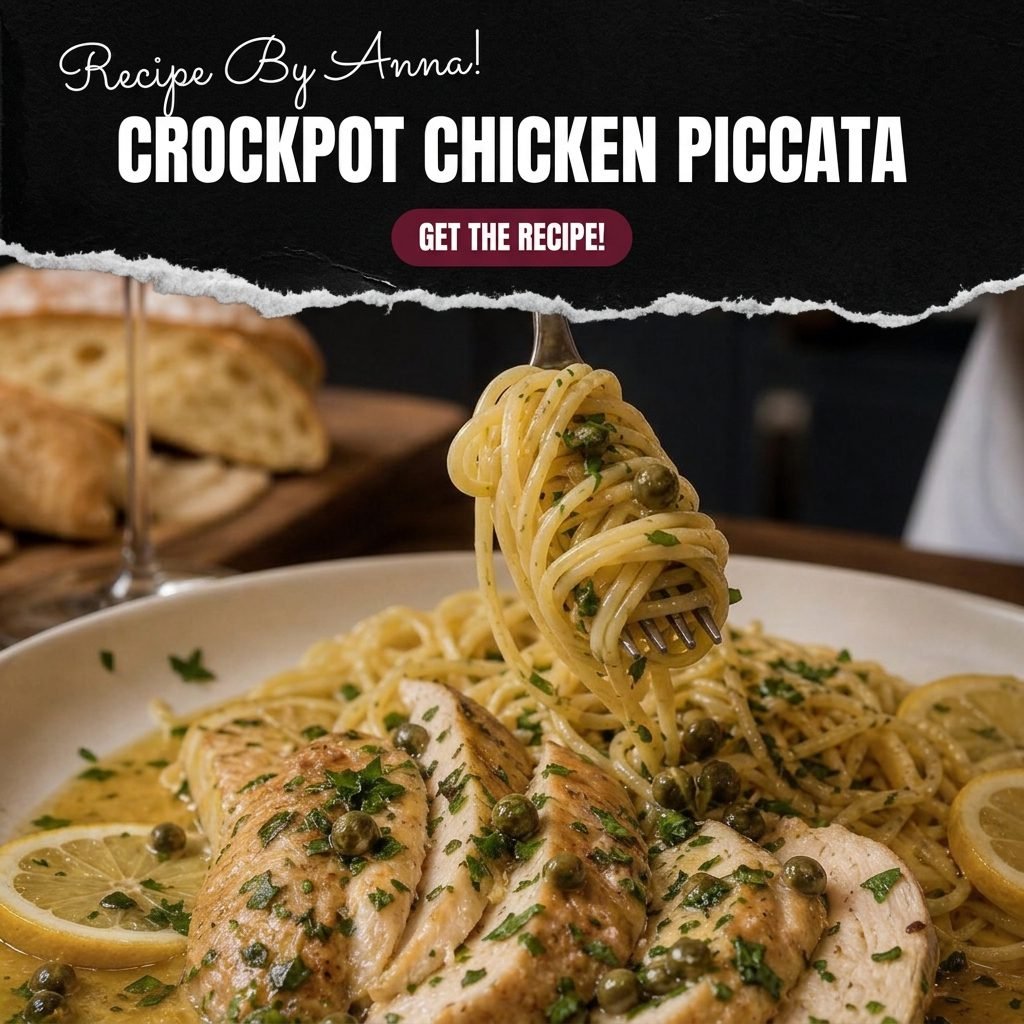
Mediterranean Crockpot Recipe | Crockpot Chicken Piccata
Chicken piccata is one of those dishes that tastes like somebody cared a lot — tender chicken in a bright, buttery lemon sauce studded with salty little capers, the kind of plate that turns a Tuesday into a small occasion. The catch has always been that it’s a last-minute pan dish: dredge, fry, deglaze, whisk, sauce, plate, eat immediately while everything is at its most dramatic. Delicious. Also slightly frantic. This crockpot version keeps every bit of the flavor and moves all the work to the morning, so dinner assembles itself while you’re out living your life. You walk back into the house at six, the kitchen smells like an Italian restaurant that likes you personally, and all that’s left is boiling pasta and stirring butter into a sauce.
Here’s the honest engineering, because piccata fans deserve the truth: the slow cooker trades the golden pan-fried crust for something better on a weeknight — chicken so tender it slices like a sigh, and a lemony broth that transforms, in three minutes at the end, into a glossy, restaurant-style sauce. The trick is doing piccata backwards. The chicken braises gently in lemon, garlic, and broth all afternoon. Then, at the end, you thicken that braising liquid with a cornstarch slurry, mount it with butter, and stir in the capers and a hit of fresh lemon. That final squeeze is non-negotiable — long-cooked lemon mellows into something round and sweet, and piccata lives on the bright note. Five minutes of finishing is the entire difference between “slow cooker lemon chicken” and actual piccata. We are making actual piccata.
Serve it over spaghetti, angel hair, rice, or mashed potatoes, scatter parsley with conviction, and listen to the table go quiet. Four servings from five minutes of morning prep — and 4 p.m. you will think 9 a.m. you is an absolute genius. Future-praise is the best part of slow cooking, and this recipe earns it in full.
Why the Crockpot Nails Piccata
The flavor backbone of piccata is the trio: lemon, capers, butter. In the pan version, those flavors build in ten fast minutes; in the crockpot, we split the trio across the day. Lemon juice and garlic go in at the start, where hours of gentle heat round their sharp edges into a mellow, savory depth — the braising liquid does the slow work. Capers and butter join at the end, where their bright, salty pop and glossy richness stay vivid instead of cooked down. Add a final squeeze of fresh lemon and its zest at serving, and you get both dimensions of the lemon: the slow, mellow base and the fresh, sharp top. That layering is why this tastes like real piccata and not like lemon-scented chicken soup.
The other quiet hero is the flour dredge. A light dusting on the chicken before it goes into the pot does two jobs: it seasons the surface and, as the chicken braises, a little of that flour slips off into the liquid and gives the eventual sauce a head start on body. By the time you whisk in the cornstarch slurry, you’re thickening a liquid that already has depth — broth, garlic, lemon, chicken juices, and the fond of a whole afternoon. And because boneless chicken breasts are lean and quick to dry out, the crockpot’s moist, steady heat is genuinely their friend: low and slow at a gentle simmer keeps them tender for a wide window, whereas a hot pan shows no such mercy. This is the rare classic where the slow cooker isn’t a compromise. It’s a strategy.
⏱️ 10 MIN PREP + 4 HRS LOW | 🍋 LEMON-CAPER-BUTTER | 🍝 WEEKNIGHT ELEGANT
- Prep Time: 10 minutes (morning)
- Cook Time: 4 hours on LOW (or 2 1/2 to 3 hours on HIGH — see the FAQ)
- Finish Time: 10 minutes for the sauce and pasta
- Yield: 4 servings
The Counter Kit
Slow cooker plus one small saucepan:
- 4- to 6-quart slow cooker — the sweet spot for four breasts in a single snug layer; snug is good here, it keeps the liquid shallow and flavorful.
- Shallow dish and fork — for the flour dredge.
- Small saucepan and whisk — the three-minute sauce finale. A skillet works too; the sauce doesn’t care what it’s thickened in.
- Instant-read thermometer — chicken is done at 165°F, and lean breasts go from perfect to parched quickly even on LOW. The thermometer is the difference between “tender” and “tribute to cardboard.”
- Pasta pot — for the spaghetti finale.
- Microplane or zester — for the finishing lemon zest, which is the difference between good and “wait, what did you do to this.”
Ingredients (With Labels)
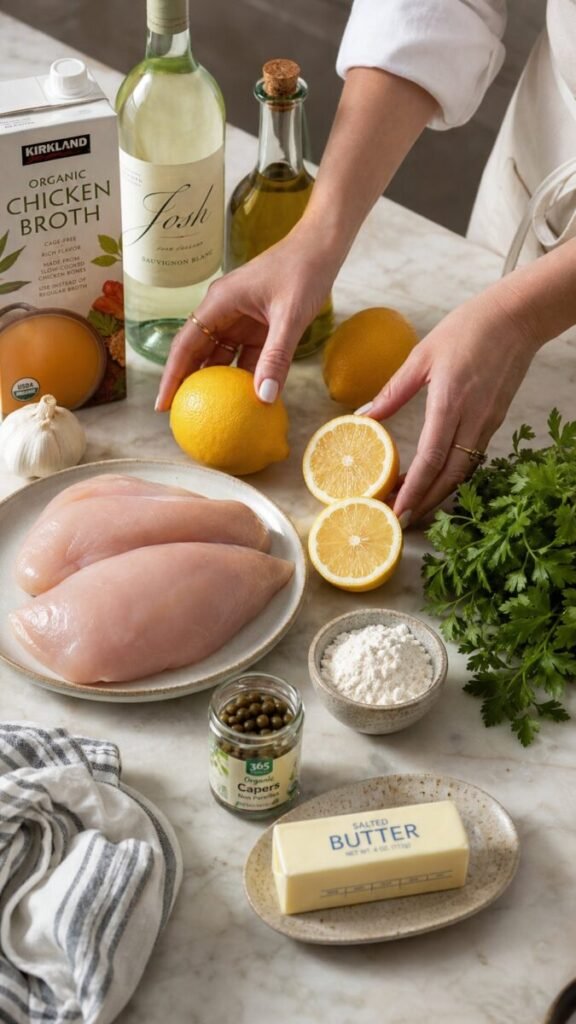
🍗 The Chicken
- Boneless, skinless chicken breasts: 2 lbs (4 medium) — similar size so they finish together; a quick pound to even thickness helps the shy little ones keep up
- All-purpose flour: 1/4 cup, for dusting
- Salt and black pepper: generously, both sides
- Olive oil: 1 tablespoon (only if you take the optional sear — below)
🍋 The Morning Braising Liquid
- Chicken broth: 1 cup, low sodium — the sauce’s foundation and your salt insurance
- Lemon juice: 1/4 cup (about 1 1/2 lemons) — half the lemon now, the rest saved for the finish
- Garlic: 4 cloves, smashed and peeled — smashed, not minced; long cooking turns minced garlic bitter and dusty
- Dry white wine: 1/4 cup (optional) — Pinot Grigio or Sauvignon Blanc; extra broth plus a splash of white vinegar at the end stands in beautifully
🧈 The Five-Minute Finish
- Cornstarch: 1 tablespoon stirred into 2 tablespoons cold water — the slurry that turns broth into sauce
- Unsalted butter: 3 tablespoons, cold and cubed — swirled in off the heat for gloss and body
- Capers: 3 tablespoons, drained — the salty signature; rinsed only if your jar runs punchy
- Fresh lemon juice and zest: from the remaining half lemon — the bright top note
- Fresh parsley: 1/4 cup chopped — piccata’s green garnish and quiet flavor partner
🍝 To Serve
- Spaghetti or angel hair: 8 oz, cooked and drained — or rice, mashed potatoes, or polenta, all of which accept sauce with gratitude
- Thin lemon slices and extra parsley: for the platter, because piccata should look like a celebration of itself
Step by Step How to Make
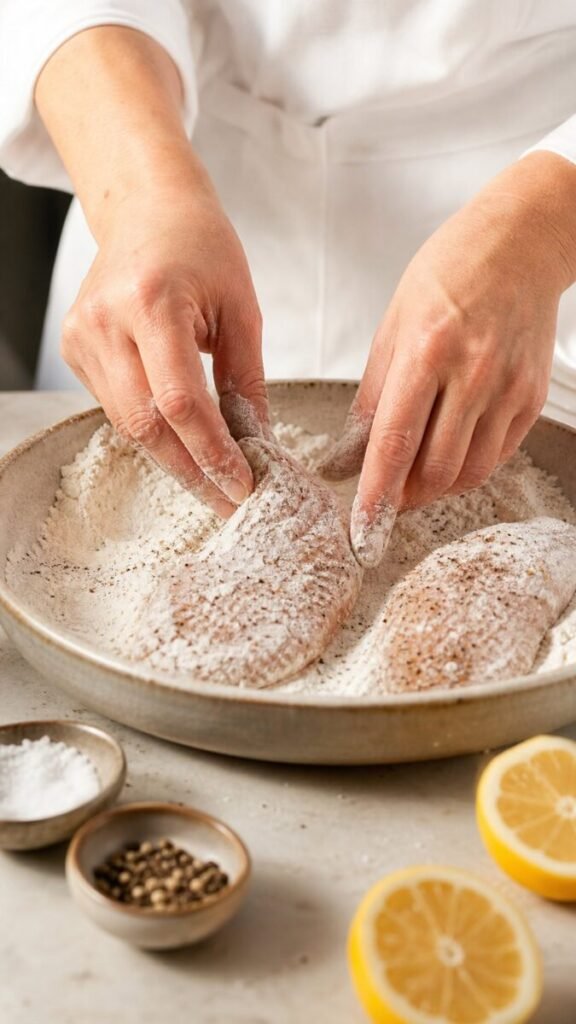
- Step 1 — Season and dust. Pat the chicken breasts dry, then season both sides generously with salt and pepper. Dredge each one lightly in the flour — a thin, even coat, shaking off the excess. This isn’t a batter; it’s a suit. The flour seasons the surface, helps the sauce later, and gives the chicken something to be proud of. Optional purist move: sear the floured breasts in a hot, oiled skillet for 2 minutes per side before they go in the crock. It adds a golden edge of flavor — but the recipe is complete without it, and mornings are busy. Choose your own adventure honestly.
- Step 2 — Build the lemon bath. Pour the broth, the 1/4 cup lemon juice, the wine (if using), and the smashed garlic into the slow cooker, and whisk it once with a fork. Nestle the floured chicken into the liquid in a single, snug layer — the liquid should come about halfway up the sides, not submerge them. This is a braise, not a swim. Halfway up is exactly where flavor lives.
- Step 3 — Low and slow. Cover and cook on LOW for 4 hours — or 2 1/2 to 3 on HIGH if the day demands it. The chicken is done when it reaches 165°F in the thickest part; check at the early end of the window, because lean breasts forgive many things but not overtime. Around hour three, your house will start smelling like a trattoria. This is normal, and it is the recipe working as intended.
- Step 4 — Rest the chicken. Lift the chicken out onto a plate and tent it loosely with foil. Ten minutes of rest lets the juices settle back into the meat, and it gives you a calm window to make the sauce. If you’re serving a crowd that likes tidy plates, slice the breasts now on a slight bias — they’ll be fork-tender, so cut with confidence and zero pressure.
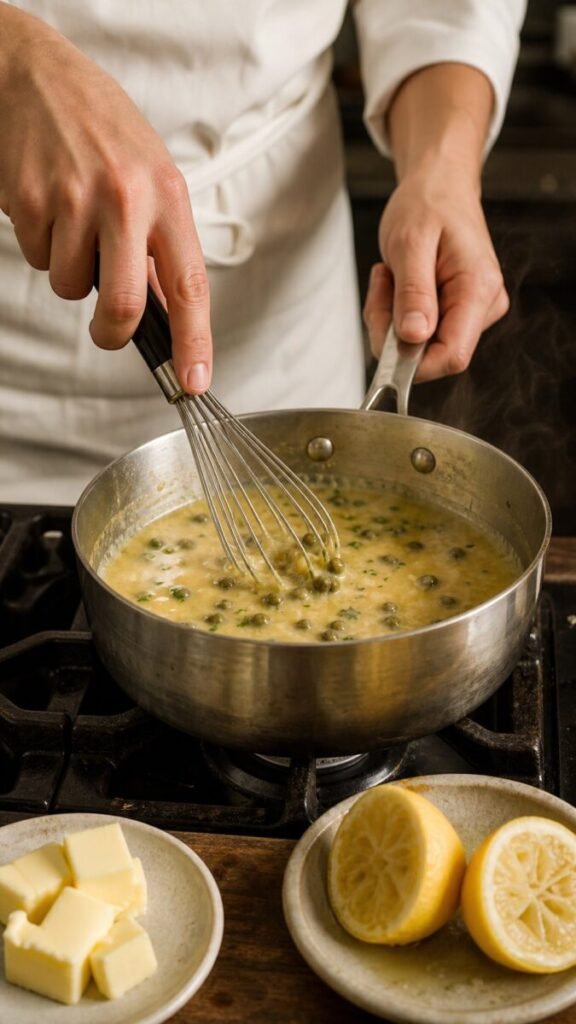
- Step 5 — Turn broth into sauce. Pour the cooking liquid from the crock into a small saucepan, fishing out the spent garlic cloves (they’ve given everything they had; release them). Bring the liquid to a gentle simmer over medium heat, give the cornstarch-water slurry one last stir, and whisk it in. Simmer 1 to 2 minutes, whisking, until the sauce thickens enough to coat a spoon — velvety, not gluey. Pull it off the heat.
- Step 6 — Butter, capers, the bright finish. Off the heat, swirl in the cold butter cubes one at a time until the sauce turns glossy. Stir in the capers, the reserved fresh lemon juice, and the zest, then taste. Needs salt? Usually just a pinch. Needs brightness? A few more drops of lemon. Needs tang? A tiny splash of white wine vinegar wakes the whole pot up. Adjust with the confidence of someone whose sauce already smells this good.
- Step 7 — Plate like a restaurant. Pile the warm pasta (or rice, or mash) on plates or one big platter, arrange the chicken on top, and spoon the sauce over everything — generously, with intent. Scatter the parsley, lay a few thin lemon slices around like you mean them, and serve immediately. Watch the first bite happen. That face is the entire reason we cook.
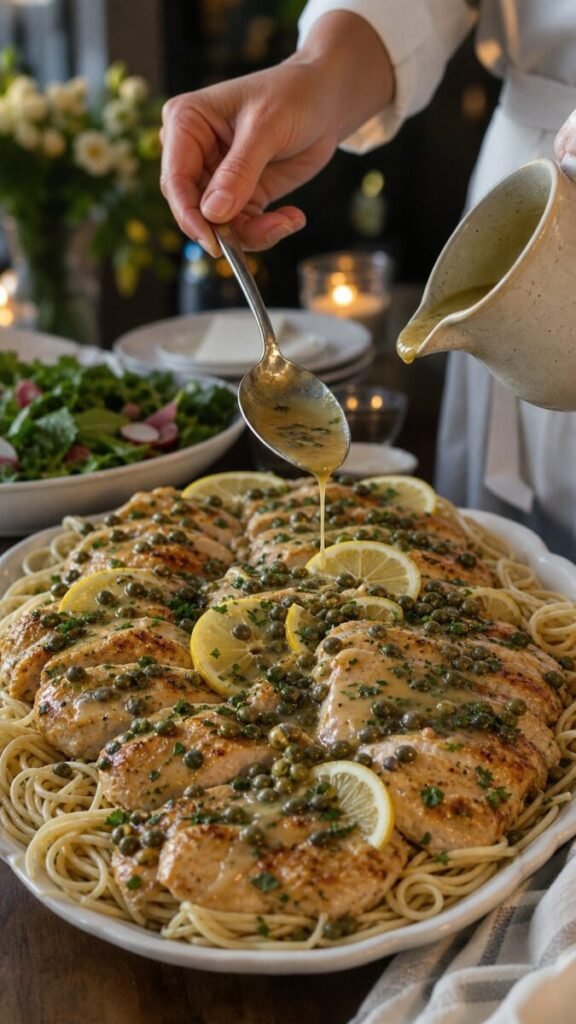
This is the slow-motion sibling of our Quick Chicken Piccata — the original weeknight pan version with the golden crust. Make the stovetop classic when you’ve got twenty minutes and a spatula; make this one when the day belongs to the slow cooker. Either way, the lemon-caper standard stays fully intact.
Sauce Wisdom
Split the lemon. Half its juice goes in at the start, where hours of heat mellow it into something round and almost sweet; the rest goes in at the end, raw and bright, with the zest for perfume. All the lemon up front tastes flat and vaguely marmalade-ish; all at the end tastes sharp and thin. The split is the recipe. Trust the split.
Smashed garlic, not minced. Minced garlic in a slow cooker turns bitter and dusty over hours; smashed cloves infuse gently and are easy to evict before the sauce reduces. One extra second of prep, zero bitterness. This is the most lopsided trade in the recipe.
Cold butter, off the heat. Swirling cold cubes into the warm (not boiling) sauce at the end is the French trick that makes pan sauces glossy and rich — it’s called mounting, and it takes thirty seconds. Boil the butter in and it can break into a greasy film; mount it and you get silk. The sauce knows the difference, and so will you.
Slurry patience. Cornstarch needs about a minute of gentle simmering, with whisking, to reach full thickness — the sauce will look thin, then suddenly won’t. Don’t panic and add more slurry mid-thicken; you’ll end up in pudding country. Whisk, wait, watch it turn. Then stop.
Taste at the very end, then season. Between the broth, the capers, and the reduction, salt levels vary every single time you make this. The final taste-and-adjust — salt, lemon, maybe a whisper of vinegar — is where home cooking becomes your cooking. Thirty seconds, every time, and the sauce comes out tasting like it has a signature.
What to Spoon It Over
Spaghetti is the classic landing pad — the sauce pools in the strands and every twirl comes up loaded — but this piccata is an equal-opportunity sauce. Buttered rice drinks it beautifully (see our Sticky Chicken Rice Bowls for proof of how well chicken and rice get along), and mashed potatoes turn the whole plate into comfort-food territory the second the lemon hits them. For mopping the last of the sauce off the plate — an activity with a devoted following — warm Crispy Olive Oil Focaccia is the official equipment, and a simple green salad with a sharp vinaigrette on the side balances the richness like it was trained for the job. It was. That’s what salads are for.
Piccata Plays
Crockpot Chicken Piccata Pasta Bake — toss the finished, sauced chicken with the cooked spaghetti, top with a handful of parmesan and mozzarella, and broil for three minutes until bubbly. The easy version of Italian-American comfort; for the full treatment, our Creamy Parmesan Tomato and Cannellini Bean Soup shows the same cheese-and-simmer energy in soup form.
Artichoke Upgrade — add a drained can of artichoke hearts to the crock for the last hour, and stir them through the finished sauce. They soak up the lemon-butter and turn the dish into something you’d order at a café with cloth napkins. Zero extra technique required.
Chicken Piccata Meatballs — swap the breasts for 2 lbs of small meatballs (a pound of ground chicken, an egg, breadcrumbs, parmesan, salt, and pepper), and braise them the same way. They hold up beautifully to slow cooking, and every meatball arrives pre-sauced. Kids consider this the superior format, and they’re not wrong.
Caper-Heavy Classic — double the capers and add thin rings of sliced shallot to the morning liquid. Sharper, more assertive, closer to the old-school trattoria version. Caper people know who they are, and this one is for them.
Creamy Piccata — stir 1/4 cup of heavy cream into the finished sauce along with the butter. Rounder, gentler, faintly luxurious — the version for nights when you want the lemon to whisper instead of sing. All versions are correct. The lemon respects range.
Dinner by the Numbers
| Nutrient | Per Serving (1 of 4, with sauce, pasta not included) |
|---|---|
| Calories | 365 kcal |
| Protein | 42 g |
| Carbohydrates | 8 g |
| Fats | 16 g |
Estimates for the chicken and sauce as written with the full butter finish — add your pasta or rice to the math separately. Forty-two grams of protein per serving puts this firmly in the “real dinner” column, and the lemon-parsley-caper flavor engine delivers it all without heavy cream (unless you invite the creamy variation, which is a guest, not a resident). Comfort food with a résumé. The numbers look like meal-prep food and the plate tastes like a bistro. Take the win.
Lemon Leftovers
The sauce is the gift that keeps giving: store leftover chicken and sauce together, covered, in the fridge for up to 3 days. The flavors keep improving overnight — the lemon settles in, the capers mellow, and day-two piccata over fresh pasta is a lunch people have been known to hoard. Reheat gently, covered, in a 325°F oven or in a skillet over medium-low with a splash of broth.
Two reheat notes worth their salt: the sauce will thicken in the cold fridge and loosen again as it warms — if it stays shy, whisk in a tablespoon of broth or water, never more heat, because boiling is what breaks butter sauces into greasy sadness. And slice-then-reheat beats reheat-then-slice for even warming, so if you stored the breasts whole, slice them cold first. Small moves, big texture dividends.
Freezing works for the chicken and sauce as a unit: cool completely, freeze airtight for up to 2 months, thaw overnight in the fridge, and reheat gently with a fresh squeeze of lemon to wake it up. The chicken softens a shade and the parsley sits out the reunion (stir in fresh), but the lemon-caper soul survives the freezer intact. A future dinner of piccata waiting in the icebox is a fine thing to know about on a hard Thursday.
Slow Cooker Stumbles
Dry, stringy chicken. The breasts cooked past their window — even on LOW, lean chicken breasts have a finishing line, and it’s usually right around the four-hour mark. Check at 3 1/2 hours the first time you make this, note your cooker’s temperament, and pull at 165°F. If a batch runs dry despite your best behavior, slice it, drown it kindly in extra sauce, and serve it over mash — sauce and starch are the two oldest fixes in the cookbook.
Thin, watery sauce. The slurry never got its full minute of simmering, or the liquid was doubled by a generous broth pour. Simmer the sauce a touch longer with extra whisking before adding more slurry — cornstarch thickens gradually and then all at once. And measure the morning liquid honestly: one cup of broth is the whole design, because the chicken contributes plenty of its own juices as it braises.
Sharp, almost bitter lemon edge. All the lemon went in at the start, or the zest boiled. Long-cooked lemon juice is mellow and lovely, but zest needs the gentle treatment — stir it in off the heat at the end, and keep at least some of the juice for the finish. The split-lemon rule exists because a crockpot will happily cook one note all the way to flat if you let it.
Broken, greasy sauce. The butter went in over a boil and split, or the reheating was too aggressive. Prevention: cold butter, off the heat, one cube at a time. Rescue: whisk in a teaspoon of cold water or broth off the heat — nine times out of ten the sauce pulls itself back together, and nobody at the table will ever know. The tenth time, it’s still delicious over pasta, and pasta is famously nonjudgmental.
Over-salty plate. Two suspects: full-sodium broth plus capers plus a heavy salt hand on the chicken. Low-sodium broth is the recipe’s built-in insurance — it hands the salt decisions to the end of the day, when you can taste everything together. If a finished sauce runs salty anyway, a squeeze of lemon and a pat of butter soften the edge; over pasta or potatoes, it usually disappears entirely. Starch is a peacemaker.
Piccata Questions
Can I use chicken thighs instead of breasts?
Yes, and boldly — boneless, skinless thighs are the more forgiving cut for slow cooking, with a wider window before they dry out, and their richer flavor stands up happily to lemon and capers. Same method, same times, and you can skip the pounding. The trade is a slightly less classic look and slightly more fat in the sauce. Many piccata veterans have switched to thighs permanently and report zero regrets.
Can I cook it on HIGH instead of LOW?
Yes — 2 1/2 to 3 hours on HIGH, checking at 2 1/2, because breasts dry faster at the higher setting. HIGH is the right call when the afternoon got away from you; LOW is the right call whenever it’s available, since the gentle simmer keeps the chicken plump longest and the flavor mellowing is nicer. Both get you to the same sauce — the difference is all in the window of tenderness.
What exactly are capers, and can I skip them?
Capers are the unopened flower buds of a caper bush, pickled in brine — tiny, green, salty, and faintly floral, and they’re the signature sprinkle of piccata. Skipping them leaves you with a very nice lemon-butter chicken, and there’s no shame in that plate. The closest substitute is chopped green olives (same briny salt, slightly bigger attitude). But if the dish has a soul, the capers are holding it, so I’d sooner add them to the regular shopping list than leave them out.
Can I make this gluten-free?
Easily. Skip the flour dredge (season the chicken and go — the sauce barely notices), and the cornstarch slurry is already gluten-free. Serve it over rice or mashed potatoes instead of pasta, and dinner is fully GF with nothing lost but the noodles. The lemon-caper engine doesn’t need flour to run. It never did.
Can I prep it the night before?
Almost — season and flour the chicken and refrigerate it, and mix the braising liquid in the crock’s insert and refrigerate that separately too. In the morning, combine, and you’re ninety seconds from walking out the door. What I wouldn’t do is leave the assembled pot in the fridge overnight with the chicken submerged — the lemon starts “cooking” the surface like a ceviche, and the texture goes slightly chalky. Mornings are short, but they’re not that short.
What if my sauce tastes flat even after the lemon?
Season in this order and it will come alive: a pinch of salt, a few more drops of lemon, and — the secret weapon — a tiny splash of white wine vinegar. Fat dulls flavor and acid sharpens it, so a buttery sauce usually needs one more push of acid to taste as bright as it smells. Adjust, taste, adjust again. The sauce tells you what it needs; the trick is tasting like you’re listening. For another masterclass in the bright-and-rich balance, our Crockpot Hot and Sour Soup runs the same play in a completely different kitchen.
Slow-Cooked Chicken · Fresh Lemon · Capers · Butter Sauce
Crockpot Chicken Piccata with Lemon-Caper Butter Sauce
Chicken breasts gently cooked in lemon, garlic and broth, then finished with a glossy butter sauce, briny capers and fresh lemon zest. A slow-cooker take on chicken piccata, served over pasta or your favorite sauce-catching side.
Ingredients
As an Amazon Associate, we earn from qualifying purchases. Ingredient and equipment links below are affiliate links.
For the Chicken
- Boneless, skinless chicken breasts, fully thawed, similar thickness 2 lb / 907 g, about 4 breasts
- All-purpose flour, for a light dredge ¼ cup
- Salt to taste
- Black pepper to taste
- Olive oil, only for optional searing 1 tbsp
For the Braising Liquid
- Low-sodium chicken broth 1 cup
- Fresh lemon juice ¼ cup
- Garlic, peeled and smashed 4 cloves
- Dry white wine, optional, or additional chicken broth ¼ cup
For the Lemon-Caper Butter Finish
- Cornstarch 1 tbsp
- Cold water, tap water is fine 2 tbsp
- Unsalted butter, cold and cubed 3 tbsp
- Capers, drained 3 tbsp
- Fresh lemon, zest and juice for finishing ½ lemon, added to taste
- Fresh parsley, chopped ¼ cup
- White wine vinegar, optional a few drops, to taste
Plan on about 2 lemons, plus extra for garnish. Measure ¼ cup juice for the slow cooker separately from the finishing juice; fruit yields vary. Zest the finishing half before squeezing it.
For Serving
- Spaghetti or angel hair, cooked separately 8 oz / 227 g dry
- Rice, mashed potatoes or polenta optional alternatives to pasta
- Thin lemon slices, optional garnish a few
- Extra parsley, optional garnish to taste
Equipment
- Slow cooker 4–6 quart, suitably sized
- Shallow dish and fork for the flour dredge
- Small saucepan and whisk for finishing the sauce
- Instant-read food thermometer for checking the chicken
- Pasta pot if serving with pasta
- Fine zester for the finishing lemon
- Skillet, optional for searing
How to Make It
- Season and lightly flour the chicken Pat the fully thawed chicken dry; do not rinse raw poultry. Season lightly with salt and pepper. Dredge in the flour, shaking off the excess. Discard flour that has contacted the raw chicken. If desired, sear in the olive oil over medium-high heat for about 2 minutes per side, then transfer immediately to the slow cooker and begin cooking.
- Add the braising liquid Combine the chicken broth, ¼ cup lemon juice, smashed garlic and optional wine or extra broth in the slow cooker. Nestle the chicken into the liquid in a snug, mostly single layer. It does not need to be submerged. Follow your slow cooker’s recommended minimum fill level rather than adding excess liquid just to cover the chicken.
- Cook to temperature Cover and cook on LOW for about 4 hours, or HIGH for about 2½–3 hours. Begin checking around 3 hours on LOW or 2 hours on HIGH, especially with smaller breasts or a hot-running cooker. Check each breast in its thickest part: the chicken must reach at least 165°F (74°C). Continue cooking if needed and avoid leaving lean breasts cooking long after they are done.
- Rest the chicken and cook the pasta Transfer the cooked chicken to a clean plate and loosely cover while you finish the sauce. Leave the breasts whole during this brief rest. If serving with pasta, cook it according to package directions, timing it to finish with the sauce.
- Thicken the cooking liquid Carefully transfer the cooking liquid to a saucepan and remove the garlic cloves. Mix the cornstarch with 2 tablespoons cold water until smooth. Bring the cooking liquid to a simmer, stir the slurry again and gradually whisk it in. Simmer for 1–2 minutes, stirring, until the sauce coats a spoon. You may not need all the slurry if little liquid remains.
- Finish with butter, capers and lemon Remove the saucepan from the heat and let active bubbling stop. Whisk in the cold butter a few cubes at a time until incorporated. Stir in the drained capers, then add the finishing lemon zest and juice gradually to taste. Adjust salt and pepper only after tasting the caper-seasoned sauce. Add a few drops of optional vinegar if desired.
- Plate and garnish Slice the rested chicken if desired. Divide the warm pasta or other prepared base among four plates, add the chicken and spoon the sauce over everything. Scatter with the chopped parsley and optional lemon slices. Serve immediately.
*Timing varies with chicken thickness, starting temperature, cooker size and appliance performance. The LOW estimate includes 10 minutes prep and about 10 minutes finishing; optional searing and separately preparing sides may add time. Use the chicken’s internal temperature, not the timer alone.
Use fully thawed chicken and start cooking immediately after assembly. If you choose the optional sear, continue cooking without interruption; do not partially cook the chicken and refrigerate it to finish later. Slow cooking does not guarantee moist chicken if the breasts are overcooked.
For an alcohol-free version, replace the wine with broth; slow cooking does not reliably remove all alcohol. For gluten-free preparation, omit the flour, verify broth and other packaged ingredients, and choose a gluten-free serving base.
Nutrition
| Nutrient | Source estimate per serving (¼ of chicken and sauce) |
|---|---|
| Calories | 365 kcal |
| Protein | 42 g |
| Carbohydrates | 8 g |
| Fat | 16 g |
Figures supplied with the original recipe, not independently calculated. Pasta and other serving bases are excluded. Actual values depend on chicken weight, retained flour, optional searing oil and sauce portions. Nutrition microdata is omitted pending verification.