Easy Snack: Candied Kielbasa Bites
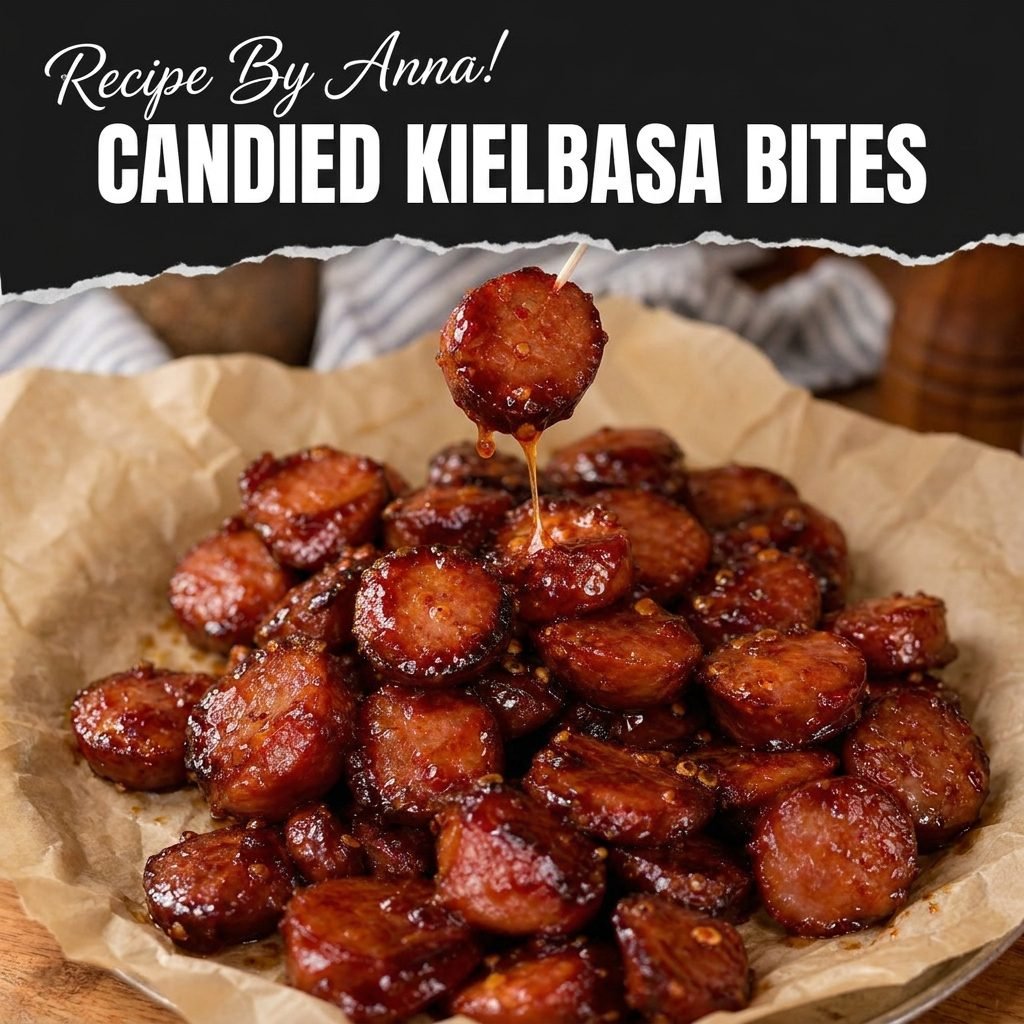
Some snacks are projects, and some snacks are three things in a pan that come out tasting like you spent the afternoon. Candied kielbasa bites are firmly the second kind: a ring of smoked kielbasa sliced into coins, tossed with brown sugar and ketchup, and baked until the sugar stops being sauce and starts being candy — a dark, glossy lacquer with drag and pull and sticky edges, wrapped around smoky, garlicky sausage that was already fully cooked before anything happened to it. This is old church-supper food, the kind of recipe that traveled on index cards for forty years before the internet found it, and the reason it survived is simple: sweet, smoky, salty, and eaten off a toothpick is close to a perfect food format. One pound of kielbasa becomes about thirty-six bites, and thirty-six bites is a number that expires fast.
The whole recipe is one honest process wearing a party costume: you are making candy that happens to have sausage in it. Brown sugar and ketchup are mostly sugar and water, and an hour in the oven is a slow reduction — the water leaves, the sugar concentrates, and the sauce walks from ketchup, through syrup, and arrives at lacquer. Pull the pan at lacquer and every coin comes out glazed like a ham at Easter; walk away past lacquer and the same sugar crosses into burnt and bitter, because sugar is an honest partner that way. The entire technique — and there is exactly one — is knowing when to pull, and the doneness test is visual and foolproof: the glaze coats and stops pooling, and a spoon dragged through it leaves a slow-closing trail. No thermometer, no faith, just watching. Well, watching and tossing, and I’ll get to the toss.
Honest notes before we start. This is snack food with a sugar budget, and I won’t pretend otherwise — fifty calories a bite, and nobody has ever eaten one bite. The three ingredients are the whole recipe: kielbasa, brown sugar, ketchup. Worcestershire, red pepper flakes, and mustard are legal bench additions that don’t count against the three, the same way a garnish doesn’t count against a soup. And use a rimmed pan, please — the glaze bubbles, and sugar on an oven floor is how a perfectly good snack ends with the smoke alarm doing commentary. Forty-five minutes, three ingredients, one pan. Let’s candy some sausage.
The Sugar on the Smoke
Start with why this pairing works, because it’s older than all of us and worth understanding. Smoke and sugar are one of the great flavor couples — think glazed ham, candied bacon, burnt ends — and the reason is contrast with reinforcement. Smoke brings bitterness, salt, and a low, savory depth; sugar brings sweetness and browning; and each one makes the other more itself, the way salt makes chocolate taste more chocolatey. Kielbasa arrives pre-smoked from the store, so the smoke is already in the meat before you start, and every layer you add on top is built to stand on it: the brown sugar for caramel notes, the ketchup for acid and body, the rendered fat of the sausage itself to carry all of it. You’re not seasoning the sausage so much as building it a suit.
Now the candy physics, because this is the paragraph that saves the recipe. Ketchup, whatever else it is, is about a quarter sugar by weight, and it’s mostly water; brown sugar is sugar with a little molasses. Combined, you have a thin sugar syrup in tomato disguise, and baking does to it what a candy maker does on purpose: evaporate the water until the sugar concentration climbs past sauce, past syrup, and into tack. That’s the lacquer. The acid in the ketchup earns its spot here — straight sugar on smoked meat is one-note cloying, and the vinegar’s tang plus the tomato’s own glutamates give the glaze edges and depth, a savory floor under the sweet. This is why the two-ingredient glaze has survived forty years of index cards: it’s balanced by chemistry, not by effort.
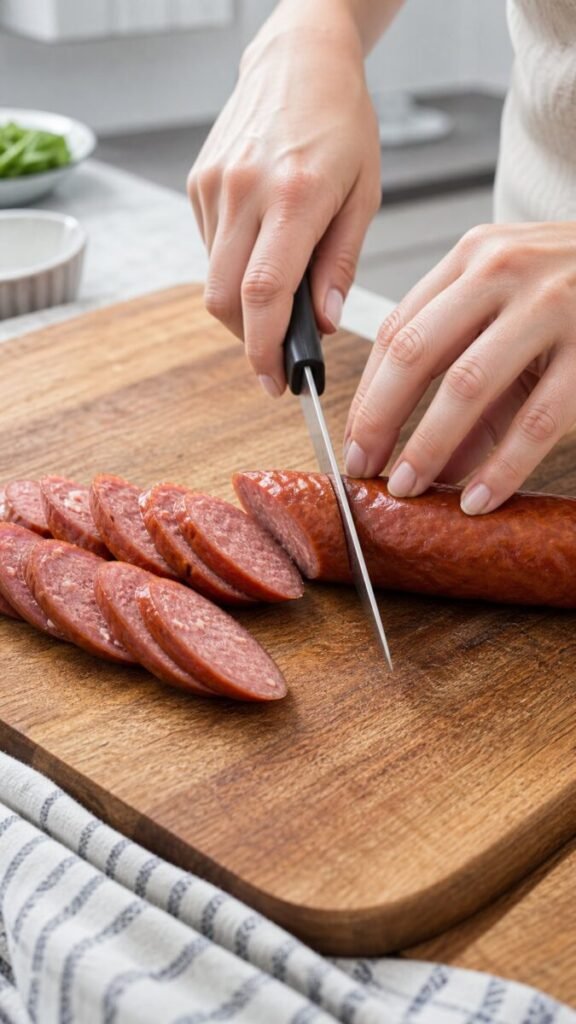
Two smaller mechanics carry real weight. First, the toss: kielbasa renders fat as it bakes, and fat plus sugar plus tomato is an emulsion that wants to separate — every toss re-coats the coins and re-blends the glaze, and it moves hot spots around so no corner scorches while another stays pale. Toss every twelve to fifteen minutes, three times across the bake, and the coating stays even all the way to lacquer. Second, the bias cut: slice the coins on a diagonal, and each one gains roughly forty percent more face than a straight round — more face means more glaze per bite and more caramelized edge, and in this recipe the edge is the best part. The two seconds of angling the knife is the highest-paid knife work in the dish.
And because it needs saying plainly: the sausage is already cooked. Kielbasa is smoked at the factory, so the oven’s job is not safety — it’s glaze construction, fat rendering, and edge caramelization, which is exactly why the recipe can afford to be this simple. There’s no doneness anxiety, no pink-center worry, no carryover math. The meat can’t undercook. Only the sugar can, and the sugar tells you when it’s done by how it behaves. It’s the rare recipe where the hard part is genuinely just paying attention, and the paying attention is mostly sniffing the kitchen and feeling pleased with yourself.
⏱️ 1 HR | 🍭 THREE INGREDIENTS | 🌭 SWEET, SMOKY, STICKY
- Prep Time: 10 minutes — the bias slicing is most of it
- Bake Time: 45 to 50 minutes, with three tosses
- Total Time: about 1 hour
- Yield: about 36 bites — snack for 6 to 8, in theory
The Bite Board
Short list, and the foil is the most important item on it:
- Rimmed sheet pan — non-negotiable. The glaze bubbles, and a flat pan sends that sugar over the edge and onto the oven floor.
- Heavy-duty foil — the glaze will weld itself to bare metal; heavy foil (doubled if you only have regular) is the peace treaty between this recipe and your pan.
- Sharp knife and cutting board — for the bias coins.
- Silicone spatula or wooden spoon — for the tosses; anything that bends with the glaze instead of fighting it.
- Big bowl — for the initial toss in the glaze. One bowl, one pan, that’s the whole dish chain.
- Toothpicks — the serving equipment. Cocktail picks if the party has standards.
- Serving platter or the foil-lined pan itself — the pan goes to the table on a trivet more often than you’d think, and nobody complains.
Ingredients (With Labels)
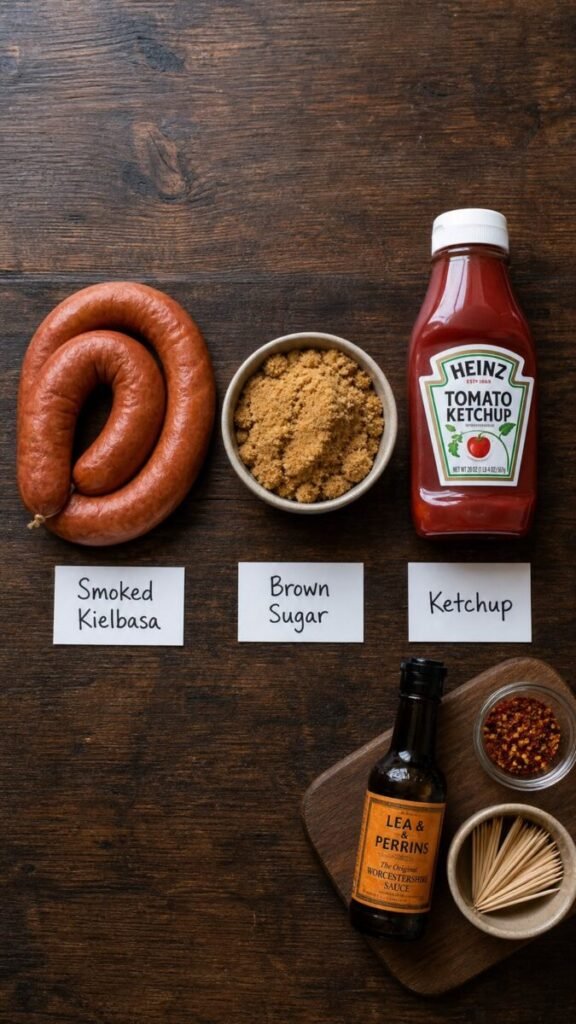
🌭 The Star
- Kielbasa: 1 lb smoked — one full ring
🍬 The Candy
- Brown sugar: ½ cup, packed — light or dark, dark is deeper
- Ketchup: ½ cup
🍴 The Bench (optional, uncounted)
- Worcestershire sauce: 1 tablespoon, for depth
- Red pepper flakes: ¼ teaspoon, for a slow burn
- Cocktail toothpicks: for serving
Step by Step How to Make
- Step 1 — Slice on the bias. Cut the kielbasa into half-inch coins, angling the knife about forty-five degrees so each coin comes out an oval instead of a round. The bias buys roughly forty percent more face per coin, and face is where the glaze lives. Thirty-six-ish coins from a pound — count them if you enjoy numbers, or don’t, the recipe doesn’t care. A sharp knife matters more than usual here: you want clean faces, not crumbly ones, because a ragged coin grabs glaze unevenly and cooks the same way.
- Step 2 — Toss in the glaze. In the big bowl, stir the brown sugar and ketchup together first — thirty seconds of stirring dissolves most of the sugar into the ketchup and makes the glaze homogenous before it ever meets heat, which is the difference between an even coat and a pan with sugar islands in it. Add the Worcestershire and the flakes if you’re playing the bench. Drop in the coins and toss with the spatula until every face is red-brown and glossy. It will look like too little glaze. It never is — the glaze doubles in power as it reduces.
- Step 3 — Lay out and go in. Heat the oven to 350°F while you line the rimmed pan with heavy foil, leaving enough overhang on two sides to grab later — that overhang is your serving handle and your cleanup miracle. Spread the glazed coins in a single layer, pouring any glaze left in the bowl over the top. Single layer matters: stacked coins steam in each other’s shadow and the glaze pools instead of reducing, and pooled glaze is soup, not candy. If they don’t all fit flat, tonight is a two-pan night, and the second pan takes the overflow.
- Step 4 — The toss schedule. Bake 45 to 50 minutes total, and pull the pan out to toss three times — at the 15-minute mark, the 30, and the 40. Each toss re-coats every coin in the reducing glaze and stirs the rendered fat back into the sauce, and the glaze visibly changes character between tosses: ketchup-thick at the first, syrupy and clinging by the second, and by the third it’s dragging strings and holding its ground. This is the recipe’s one technique, it is not optional, and it takes about twenty seconds a visit. Set a timer between them and forget about it entirely.
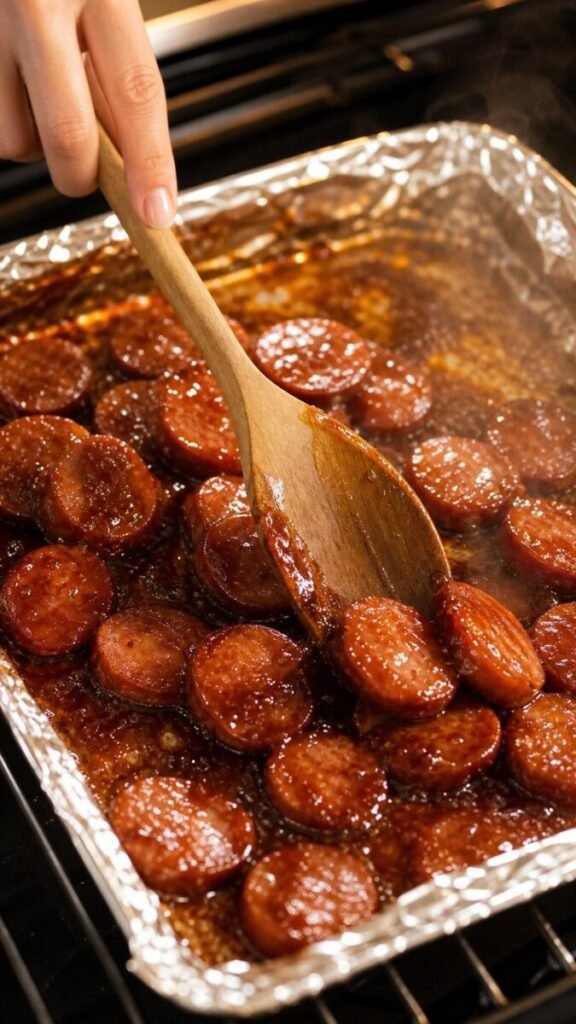
- Step 5 — The lacquer watch. Somewhere between minute 45 and 50, the glaze crosses its line, and your job is to be looking when it happens. The signs, in order: the bubbling slows and the bubbles get fat and slow; the glaze coats the coins and stops pooling in the corners; a spatula dragged through the pan leaves a trail that closes reluctantly, like honey deciding. The color goes from wet red-brown to deep amber with shine you can see across the room. Pull it there. Every minute past lacquer, the sugar moves toward burnt, and burnt sugar is bitter in a way no amount of wishing fixes.
- Step 6 — Rest, pick, scrape. Give the pan five minutes on the counter — the glaze sets from molten to candy as it cools, and bites moved too early arrive at the platter dripping while bites moved at five minutes arrive wearing a shell. Spear them with toothpicks and pile them on the serving plate, or set the whole pan on a trivet and let the party come to it. Then the part I refuse to skip: the pan candy. The glaze that cooked onto the foil between the coins is the crispest, deepest candy in the entire recipe, and scraping it up with a spatula to eat standing at the counter is the cook’s tax. It has always been collected. It always will be.
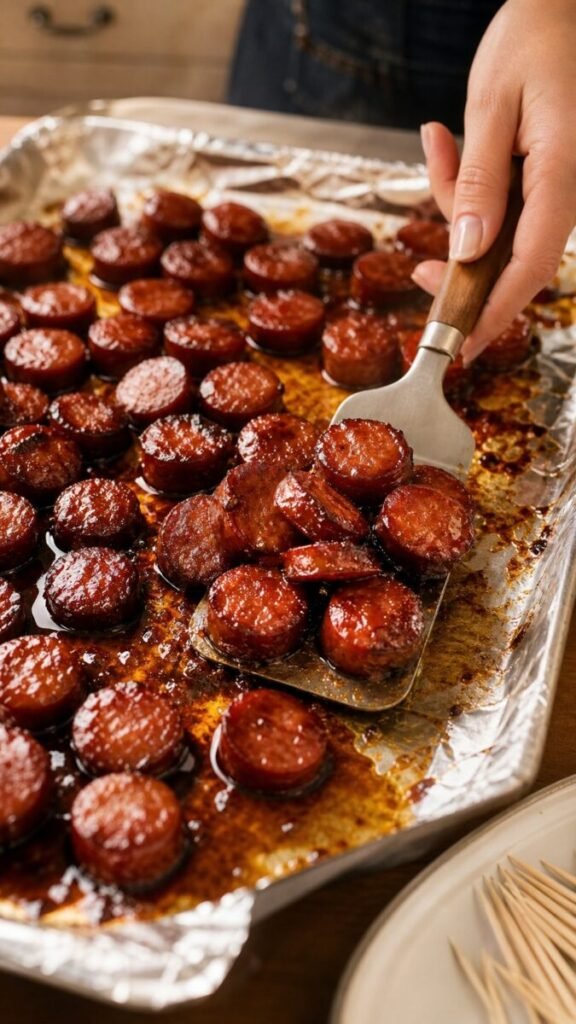
Sweet, smoky, and gone in one round — these bites and the Rotel sausage balls are the sausage family’s two best party tricks, and they belong on the same table.
Anna’s Kitchen Notes
Buy real smoke. The recipe’s floor is the sausage, and “kielbasa-style” rings vary wildly — look for one that says smoked, from a brand or a deli case you trust, because the garlic-and-smoke seasoning is doing half the flavor work before the sugar even shows up. Turkey kielbasa works fine if that’s your house’s sausage, with a slightly leaner, slightly less fatty glaze. The one thing not to substitute is a fresh, raw sausage — that’s a different recipe with different rules, and it will fight you.
Heavy foil is the recipe’s peace treaty. Molten sugar on bare metal is a weld, and scrubbing candied pans is how people stop making perfectly good recipes. Heavy-duty foil, overhang on two sides, and when the pan cools, the whole liner lifts out and the pan underneath is clean. If you only have regular foil, double it. If you have neither, a parchment lining works and the pan candy comes up in sheets, which some people consider the superior outcome.
The toss is the technique. Everything else in this recipe is grocery shopping. The tosses re-coat the coins as the glaze reduces, blend the rendering fat back into the sauce, and rotate the pan’s hot and cool spots so the lacquer arrives everywhere at the same minute. Three tosses, twenty seconds each, and the difference between tossed and un-tossed is the difference between thirty-six glazed bites and a pan of pale coins floating in a burnt corner.
Two pans, never one crowded. Doubling for a crowd? Two pans, side by side, coins in a single layer each. Crowding one pan stacks the coins, the stack steams, and the glaze that should be reducing is busy thinning itself back out with condensation — the classic route to soup instead of candy. The oven holds two pans at 350°F without complaint, and the tosses can happen in one trip.
Count the minutes honestly. Ovens vary, and the 45-to-50 window is calibrated for a true 350°F. The pull signal is the glaze’s behavior, never the clock: coating, no pooling, slow-closing trail, deep amber shine. If your oven runs cool, the bake might take 55 — watch the glaze, not the timer, and the recipe will tell you when it’s ready. Sugar always does.
The Snack Shelf
A snack this sweet and smoky wants company that pushes back — salty, creamy, or crunchy, and cool if possible. The pigs in a blanket are the natural co-star: same smoked-sausage energy in a buttery dough jacket, and the two trays together cover the hand-food aisle of any party.
To fill out the table: the budget party snacks lineup has the full menu math for feeding a crowd cheaply, the Texas trash dip is the warm, cheesy counterweight, and the air fryer carrot bacon is this bite’s candied-bacon-adjacent cousin from the vegetable bench. And when the party’s over and there’s kielbasa left over, the pork sausage and potato soup is the same smoke in soup form for the next night. One sausage, two dinners, zero regrets.
Same Glaze, Other Meats
The horseradish build. The old church-supper version: a quarter cup of prepared horseradish stirred into the glaze, cutting the sugar with a slow nasal burn. It’s the most grown-up version of the recipe and the one people ask about, and it converts even the ketchup skeptics.
The BBQ swap. Equal parts brown sugar and your favorite BBQ sauce instead of ketchup — the glaze goes smokier and looser, and the candy pulls a shade earlier, so start watching at minute 40. This is the version for the tailgate, by unwritten law.
Spicy maple-Dijon. Maple syrup for half the brown sugar, a tablespoon of Dijon in with the ketchup, flakes on top — sweeter, sharper, a little more polite. The glaze runs a touch thinner, so give the last five minutes your full attention.
Cocktail sausages, the bite-size build. The same glaze over a bag of little smoked cocktail sausages instead of coins — party-perfect, three bites to one coin, and the glaze-to-meat ratio climbs deliciously. Reduce the bake to 35 to 40 minutes; the little ones candy faster.
Pineapple alongside. Toothpicked chunks of canned pineapple between the bites, or a few tucked into the pan for the last twenty minutes — the juice caramelizes into the glaze and the bright fruit cuts the richness. It’s the ham-and-pineapple principle, in snack form, and it works for exactly the same reason.
The slow-cooker version, honestly rated. Everything in the pot, low for 3 to 4 hours, stir twice. It’s the hands-off route and the glaze stays sauce rather than turning candy — glossy and clingy, but no lacquer, no crisped edges. About eighty percent of the experience and zero percent of the oven. For a potluck where the pan has to sit for hours, it’s actually the better tool; for eating at home tonight, the oven wins on texture.
The Piece Count
| Nutrient | Per Bite (1 of 36) |
|---|---|
| Calories | 50 kcal |
| Protein | 2 g |
| Carbohydrates | 4 g |
| Fats | 3 g |
Estimates as written, glaze fully accounted, bench extras included. Fifty calories a bite is the kind of number that sounds innocent until you do the arithmetic on a plate of six, which is why I include it — this is sugar-glazed sausage wearing a snack’s badge, and honest labels are the house rule. The protein rides along at two grams a bite, the fat comes from the sausage and mostly renders into the glaze it travels in, and the carbohydrates are nearly all the candy doing what candy does. The serving strategy, if strategy is the word: put out the plate, note the time, and accept whatever the guests decide the serving size is. It’s never been one bite. It will never be one bite.
The Candy Jar
Leftovers — a genuinely rare category for this recipe — keep four days in the fridge, and they reheat into something nearly as good as fresh: 350°F for 5 to 8 minutes on a foil-lined pan re-melts the lacquer and re-crisps the edges, which the microwave cannot do no matter how politely you ask. Straight from the fridge, honestly, they’re excellent cold — the glaze sets to a firm candy shell and the smoke reads louder, the same way cold pizza is a different and legitimate food. The slow-cooker hold works for parties: already-cooked bites on low, covered, hold happily for an hour.
The freezer takes them for two months, with one honest caveat: the glaze softens in the thaw and the candy edge goes matte. The fix is the same as the reheat — a few minutes in a hot oven re-lacquers what the freezer loosened, and the bites come back at about ninety percent. Freeze them in a single layer on a tray first, then bag, so you’re thawing bites instead of a brick.
Second careers, because a double batch sometimes survives: the cold remainder is a shockingly good sandwich filling with mustard and pickles; warm bites over rice with the scraped pan candy poured on top is a lazy dinner nobody planned; and chopped leftover bites folded into baked beans is the potluck move that makes people think you did something much harder than you did. Then there’s the pan candy itself, which never makes it to the fridge, because the cook collects that tax on the spot. Some traditions fund themselves.
Where It Goes Wrong
A burnt, bitter glaze. The bake ran past lacquer, or the oven runs hot, or the pan sat in a still-warm oven after the pull. Burnt sugar is bitter in a permanent way — there’s no rescuing it, only preventing it, and prevention is the drag test at minute 45: coats, stops pooling, trail closes slowly. Pull there and not one minute of optimism later. If the glaze is darkening unevenly, the pan needs rotating, not patience.
A pale, soupy pool. The other failure, and the more common one: the bake never got to reduction. Causes stack — oven running cool, glaze not stirred before the toss, coins stacked instead of single-layer, or a pan crowded into steaming. The fix for a batch in progress is simply more time: keep baking in ten-minute increments, tossing between, until the pooling stops. The fix in the future is the single layer and a true 350°F, and the recipe gets there on its own schedule.
A greasy slick on top. The sausage rendered its fat and nobody blended it back in — this is the missed-toss signature. The fat separates, sits on top of the glaze, and coats fingers instead of flavoring candy. The cure is a good stir now and a hotter finish: back in the oven for the last ten minutes with a toss halfway, and watch the glaze re-emulsify into something glossy again. Then never skip a toss again.
Tough, chewy bites. The pan stayed in long past lacquer in pursuit of crunch — the sugar was done at fifty minutes but the sausage kept drying, and dried kielbasa under candy is a jaw workout. The pull signal belongs to the glaze alone; the meat has no doneness to gain here, only moisture to lose. When in doubt, pull early — the glaze keeps setting on the counter for five minutes after.
Welded to the pan. Thin foil, or no foil at all, or bites moved cold. Molten sugar bonds to metal and to itself, and once the pan cools with the glaze on it, you’re mining instead of serving. Heavy foil with overhang, bites moved at the five-minute warm mark, and anything that still sticks releases with a firm spatula press and a slow slide. The candy left on the foil is the cook’s tax, not the pan’s.
The smoke alarm solos. Glaze bubbled over a rimless pan, or dripped off torn foil onto the oven floor, and caramelized sugar on hot metal makes smoke before it makes anything else. The rimmed pan is the whole defense, and a sheet of foil on the rack below is cheap insurance for a nervous first batch. If the alarm does go off, open a window, fan the door, and know that every cook who’s made candy has been there. The snack is usually still fine. The alarm is doing its job. Yours is the window.
Kielbasa Questions
Can I use turkey kielbasa or another smoked sausage?
Yes and yes. Turkey kielbasa works with the same method — slightly leaner, so a touch less fat renders into the glaze, and the candy is a hair less glossy for it. Any fully cooked smoked sausage plays: andouille for more fire and smoke, chicken sausage for lighter, or the little cocktail sausages for bite-size builds with a shorter bake. The one hard no is fresh, raw sausage — it needs real cooking and draining first, which changes the whole recipe. If the label says smoked and fully cooked, it belongs here.
Why isn’t my glaze sticking to the sausage?
It hasn’t reduced far enough — a glaze that coats is a glaze whose water has mostly left, and thin, sliding glaze means the bake is still at the syrup stage with time to go. Keep going in ten-minute increments with a toss between each, and watch for the signs: fat bubbles slowing, pooling stopping, a spatula trail that closes reluctantly. The glaze always sticks eventually; the only question is whether it sticks before the sausage dries, which is why the oven runs at a moderate 350°F instead of a hurried 400.
Can I make these on the stovetop instead?
Yes — a lidded skillet over medium-low, everything in at once, 15 to 20 minutes with regular stirring as the glaze thickens. It’s faster and it works, with an honest trade: no oven heat means no crisped edges and no true lacquer, just a glossy, clingy sauce — about seventy-five percent of the experience. The stovetop is the Tuesday version; the oven is the one that makes people ask what you did. Both get eaten entirely.
Can I make them ahead for a party?
Better than most snacks, honestly. Bake them fully the day before, refrigerate on the foil liner, and reheat at 350°F for 5 to 8 minutes — the glaze re-melts, re-coats, and re-sets as they cool, and the second-day version is remarkably close to the first. For a longer party, the slow cooker on low holds the finished bites warm and saucy for an hour without complaint. Assemble-ahead raw isn’t the move here; candy the day you want candy.
How spicy are they, really?
As written, barely at all — a quarter teaspoon of flakes across thirty-six bites is a warmth you have to look for, and most of what people read as spice is the smoke. The dials, in order of commitment: more flakes, a teaspoon of hot sauce in the glaze, cayenne with the brown sugar, or the horseradish build from the variations, which is the one adults describe as “interesting” before taking a third bite. Heat builds slowly in a sugar glaze, so taste at the toss, not before.
Can I make them in the air fryer?
In small batches, yes, and quickly: 350°F for 10 to 12 minutes with a shake every four, and the glaze candies in moving heat noticeably faster than the oven’s. The honest trade is attention — moving hot air takes sugar from lacquer to burnt in a shorter breath, so stay within earshot and pull at the first slow-dragging glaze. The air fryer also gives you the crispest edges of any method, which some people consider not a trade at all but the whole point.
What do I actually serve with them?
Toothpicks and contrast. Sweet-smoky-rich bites want something sharp, cool, or crunchy beside them: the pigs in a blanket and Texas trash dip from the pairings, a bowl of pickles or giardiniera, mustard for the purists, and something cold to drink within arm’s reach. For a dinner-sized evening, warm bites over rice with the pan candy scraped on top is the laziest good meal this recipe produces. The snack carries itself; the sides just keep it company.
Sweet & smoky · Three-ingredient base · Oven baked
Easy Snack: Candied Kielbasa Bites
Fully cooked smoked kielbasa sliced into bite-size coins, coated with brown sugar and ketchup, and baked until the glaze is thick, glossy, and sticky. An easy sweet-and-savory appetizer for a party platter.
As an Amazon Associate I earn from qualifying purchases.
Ingredients
The three essentials
- 1 lb fully cooked smoked kielbasa, thawed if frozen
- ½ cup packed brown sugar, light or dark
- ½ cup ketchup
Optional flavor additions
- 1 tablespoon Worcestershire sauce, optional
- ¼ teaspoon red pepper flakes, optional
Check the sausage label: “smoked” does not automatically mean fully cooked. This recipe requires kielbasa explicitly labeled fully cooked or ready to eat. Fresh or raw kielbasa needs a different cooking method.
Sticky glaze, not hard candy: the finished coating should cling to the sausage and thicken as it cools. Do not keep baking in pursuit of a brittle shell; the glaze can burn and the sausage can dry out.
The bite board kit
- Rimmed sheet pan, sized to hold the sausage in a single layer without excessive empty space
- Heavy-duty nonstick foil or oven-rated parchment
- Sharp knife and cutting board
- Mixing bowl
- Heatproof silicone spatula
- Measuring cups and spoons
- Oven mitts and a heat-resistant trivet
- Cocktail toothpicks, for serving after baking
- Serving platter
Pan size affects timing: glaze spread thinly across a very large pan can scorch before the sausage is well coated. Use a pan that holds the coins comfortably, with room to turn them but not large expanses of bare glaze.
How to make it
-
Preheat and slice the kielbasa
Heat the oven to 350°F. Line a rimmed sheet pan with heavy-duty nonstick foil, using the correct side according to its package, or oven-rated parchment. Cut the fully cooked kielbasa into approximately ½-inch slices, straight across or on a slight diagonal. Keep the pieces similar in thickness. The number of bites will vary with the sausage’s length and diameter.
-
Mix the glaze and coat the sausage
Stir the packed brown sugar and ketchup together in a mixing bowl until evenly combined; the sugar need not dissolve completely before baking. Stir in the optional Worcestershire and red pepper flakes if using. Add the kielbasa and toss gently until every piece is coated.
-
Spread into a single layer
Arrange the coated slices flat on the prepared pan. Scrape the remaining glaze over the sausage rather than spreading it over empty areas of the pan. Avoid stacking the coins. If doubling the recipe, use two appropriately sized pans instead of crowding one.
-
Bake and turn regularly
Bake for approximately 45–50 minutes, carefully turning and recoating the sausage at 15 and 30 minutes, then again around 40 minutes if still cooking. Move edge pieces toward the center and rotate the pan if it is browning unevenly. Begin watching the glaze closely after 30 minutes; its timing depends on the pan, oven, ketchup, and sausage.
-
Remove when the glaze is thick and glossy
The bites are ready when the glaze clings thickly to the sausage and a spatula drawn through it leaves a trail that closes slowly. Remove earlier if that happens before the suggested time. If still watery, continue in short 3–5-minute increments, checking closely. Do not wait for all liquid or rendered fat to disappear, and do not let the glaze become black, smoky, or bitter. Follow any reheating directions on the sausage package.
-
Rest briefly and serve warm
Place the pan on a heat-resistant trivet and rest for about 5 minutes so the glaze thickens and cools slightly. Transfer the bites with a spatula while still warm, add cocktail picks, and serve. The sugar coating may remain very hot even when the sausage is comfortable to handle, so let a test bite cool before tasting. Lift the pan by its edges with oven mitts, not by the liner.
Hot-sugar safety: avoid touching or tasting molten glaze. Do not scrape aggressively against foil, which can tear and leave fragments in the food. Keep liners contained within the pan and away from heating elements; do not line the oven floor or block airflow with foil.
Party food safety: these are perishable sausage bites, not shelf-stable candy. Keep hot-held food at 140°F or above, verified with a thermometer. Otherwise refrigerate within 2 hours, or 1 hour above 90°F. Reheat leftovers to 165°F. Check sausage and condiment labels for allergens; Worcestershire sauce commonly contains fish.