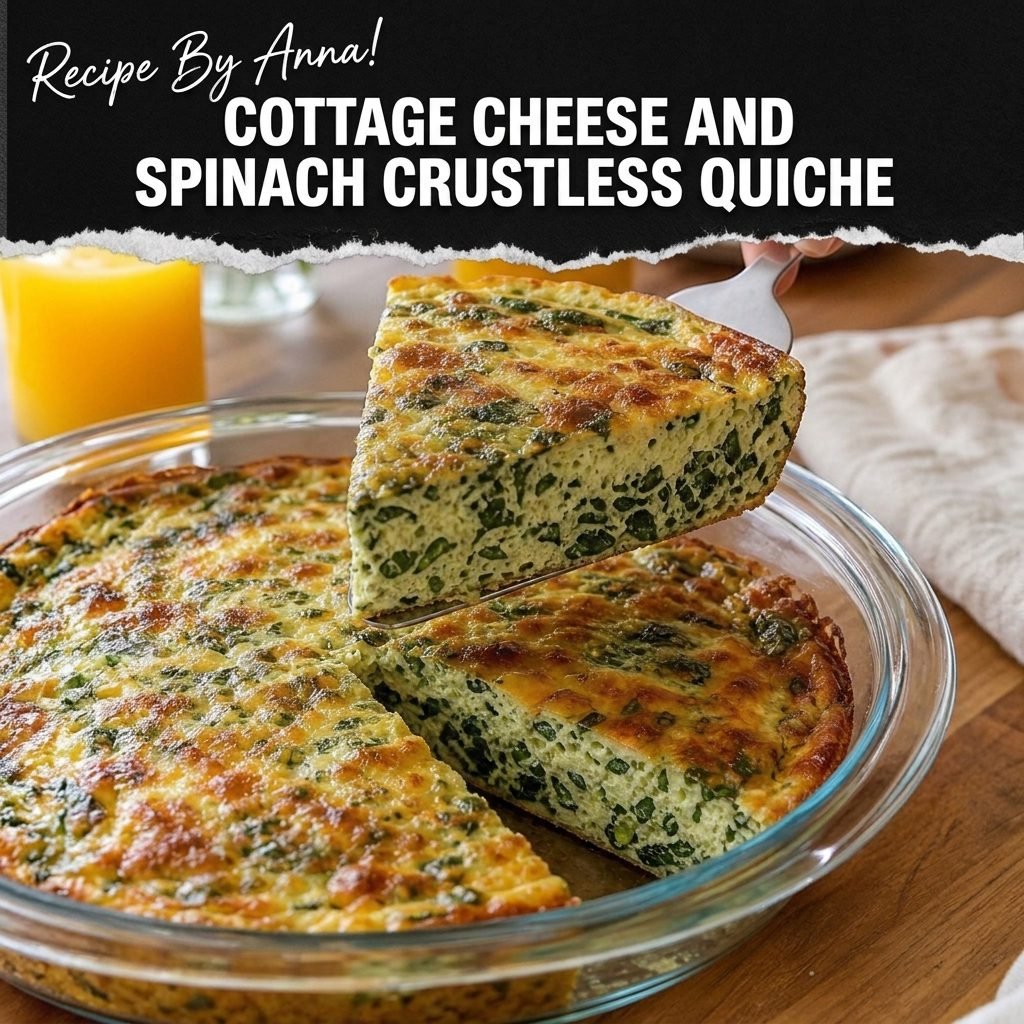
Cottage Cheese and Spinach Crustless Quiche for Effortless Brunch
Most brunch dishes make you choose between impressive and effortless. A Dutch baby demands you serve it in the next ninety seconds or watch it die. Pancakes chain you to the stove in shifts while everyone else laughs in the other room. A proper quiche wants its dough chilled, rolled, rested, and blind-baked before the filling so much as exists — that’s the better part of an hour spent on a component nobody at brunch actually came for. This cottage cheese and spinach crustless quiche is my refusal to sign that contract: fifteen minutes of hands-on work, most of it in a blender, and then the oven does the hosting while you set the table, make the coffee, and have an actual conversation. The effortless part isn’t luck. It’s structural.
The structural part is cottage cheese, an ingredient that spent decades in diet-plate exile and is finally having its rehabilitation. In a quiche, the dairy’s traditional job belongs to cream, which brings nothing to the mix but fat and water — lovely, but passive. Cottage cheese arrives with a résumé: protein, fat, tang, and body. Blitzed smooth with the eggs, it builds a custard that sets sturdy enough to slice without any crust holding its hand, carries a gentle tang that cream never could, and turns the nutrition numbers into something brunch food has no business producing — nineteen grams of protein and around 235 calories a slice. Nobody at the table will identify the cottage cheese. They will identify the second helping.
Honest notes before we start. Without a crust, the edges of this quiche are softer and the first slice always comes out a little raggedy — serve that one to yourself and call it the sneak preview. The recipe wants a frozen block of spinach, not a bag of fresh, and the difference is deliberate — frozen spinach is blanched before freezing, so it’s already cooked down and concentrated, and one squeeze in a towel finishes the job. The garlic is powdered, on purpose, and I’ll defend that below. And the whole thing can be assembled the night before and baked cold in the morning, which is the difference between a relaxed host and a person whisking eggs at 9:40 while the doorbell rings. The brunch table has enough drama. The quiche doesn’t need to add any.
The Case for No Crust
Let’s be fair to the crust before we fire it, because it does real work. A pastry crust contains the custard, insulates it from the pan’s direct heat so the edges cook gently, and contributes butter and crunch. The trouble is the invoice: the dough must be made, chilled for at least thirty minutes, rolled, fitted, chilled again, then blind-baked with pie weights for twenty minutes — an hour of technique standing between you and the part anyone actually eats. The crustless deal replaces each job wholesale. The buttered dish does the containing. A moderate 350°F oven does the insulating. And the browning, the crunch-adjacent garnish, the thing your eye lands on first? That’s the job of the cheddar on top, which bubbles and bronzes into a lid that behaves exactly like a crust’s best paragraph. Nobody misses the dough. Several people have asked for “the crust recipe” and I have had to break the news gently.
The custard itself deserves the technical paragraph, because this is where cottage cheese quietly rewrites the recipe. A quiche custard is eggs plus dairy, set by egg proteins that unwind and link up around 175°F. Cream, the traditional dairy, is fat and water — it enriches and softens, then leaves. Cottage cheese is a dairy with a job: its proteins co-set with the egg proteins, so the slice firms up enough to stand on a fork without any starch or crust to lean on. That’s also why the blender matters. Straight from the tub, cottage cheese is lumps in liquid, and lumpy custard is a texture some people never get past. Blitzed for forty-five seconds with the eggs, the curds vanish completely into a smooth, pale, pourable custard — the same move the cottage cheese pancakes on this site have been making for a year, and it works here for the same reason. Buy small-curd, and buy full-fat or 2%; fat-free cottage cheese replaces fat with water, and water is precisely what this custard is trying to avoid becoming.
Two rules protect the result, and they bookend the bake. Before: the spinach must be squeezed hard — a thawed ten-ounce block gives up nearly half a cup of water, and every drop left behind becomes a puddle under your beautiful slice. After: pull the quiche at the wobble, not the clean slice. Egg proteins that have just set hold their moisture; egg proteins that have over-set wring it out — the weeping, rubbery mess every overbaked quiche becomes has a name, syneresis, and the cure is taking the dish out while the center still shimmies like set jello. Carryover heat finishes the middle on the counter. The difference between perfect and rubbery is about four minutes of impatience, and now you know exactly where it lives.
⏱️ 15 MIN HANDS-ON | 🍳 6 SLICES | 💪 19 G PROTEIN EACH
- Prep Time: 15 minutes — most of it the spinach squeeze
- Bake Time: 40 to 50 minutes, unattended
- Rest: 10 to 15 minutes, while you set out the rest
- Total Time: about 1 hour, fifteen minutes of it yours
- Yield: 6 slices from a 9-inch pie dish or 8×8 pan
The Brunch Machine
Short list, and the blender does the heavy lifting:
- Blender — forty-five seconds turns curds into custard. A food processor works; a bowl and a whisk makes a rustic, curdy version that still slices fine.
- 9-inch pie dish or 8×8 baking pan — glass or ceramic, ideally not dark metal, which runs hot against custard.
- Clean kitchen towel — for wringing the spinach. A double layer of paper towels in a pinch.
- Rubber spatula — for scraping the blender and folding the greens in.
- Thin-bladed knife — the doneness test and the first cut.
- Wire rack — to cool the dish evenly so the bottom doesn’t sweat.
Ingredients (With Labels)

🥚 The Custard Base
- Cottage cheese: 16 oz tub, small curd, full-fat or 2%
- Eggs: 5 large
- Sharp cheddar: 1 cup shredded — half folded in, half for the top
🥬 The Greens
- Frozen spinach: 10-oz block, thawed and squeezed dry
- Scallions: 3, thinly sliced
🧂 The Seasoning Shelf
- Garlic powder: ½ teaspoon — the one place I take the powder
- Nutmeg: ¼ teaspoon, freshly grated if you can
- Salt: ¾ teaspoon
- Black pepper: ½ teaspoon
- Butter: 1 tablespoon, for the dish
Step by Step How to Make
- Step 1 — Thaw, squeeze, butter. Thaw the spinach block — warm water over it in a colander works in five minutes — then wrap it in the towel and twist until it stops giving. You’re looking for a dry, dark, dense handful and a genuinely alarming amount of green water left behind. Butter the pie dish generously, including the corners if you’re using the square pan; the butter is flavor here, but it’s also the difference between a slice that releases and a slice that stays. Heat the oven to 350°F.
- Step 2 — Blitz the custard. Into the blender: the whole tub of cottage cheese, the five eggs, the garlic powder, nutmeg, salt, and pepper. Blend on high for 45 seconds, scrape down the sides once, and give it another 10. The result should be completely smooth, pale, and pourable — no curd texture at all, closer to a thin pancake batter than to anything from the cottage cheese tub it came from. This is the step that makes the whole recipe effortless: one machine, under a minute, and the custard base is done.
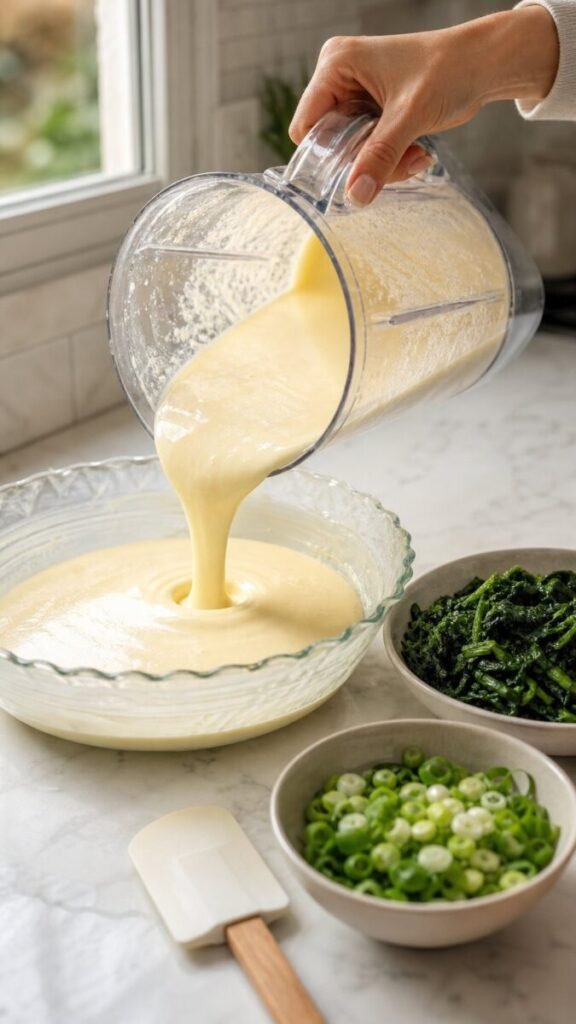
- Step 3 — Fold, pour, top. Pour the custard into a big bowl — easier to fold in than the blender jar — add the squeezed spinach, the scallions, and half the cheddar, and fold until the greens are spread evenly through. Scrape it all into the buttered dish, smooth the top, then scatter the remaining cheddar across it edge to edge. That cheese layer is the crust that isn’t: it will bubble, brown, and turn into the lid your eye eats first.
- Step 4 — Bake to the wobble. 350°F, center rack, 40 to 50 minutes. The quiche is done when the edges are puffed and set, the top is deeply golden, and the center still shimmies just slightly when you nudge the dish — like set jello, not like liquid. If you want a second opinion, slide a thin knife one inch from the edge; it should come out clean. Err on the side of pulling early: the carryover heat is finishing the center on the counter, and quiche pulled at the wobble slices clean. Quiche pulled at “definitely done” weeps on the plate. Four minutes of patience, whole different dish.
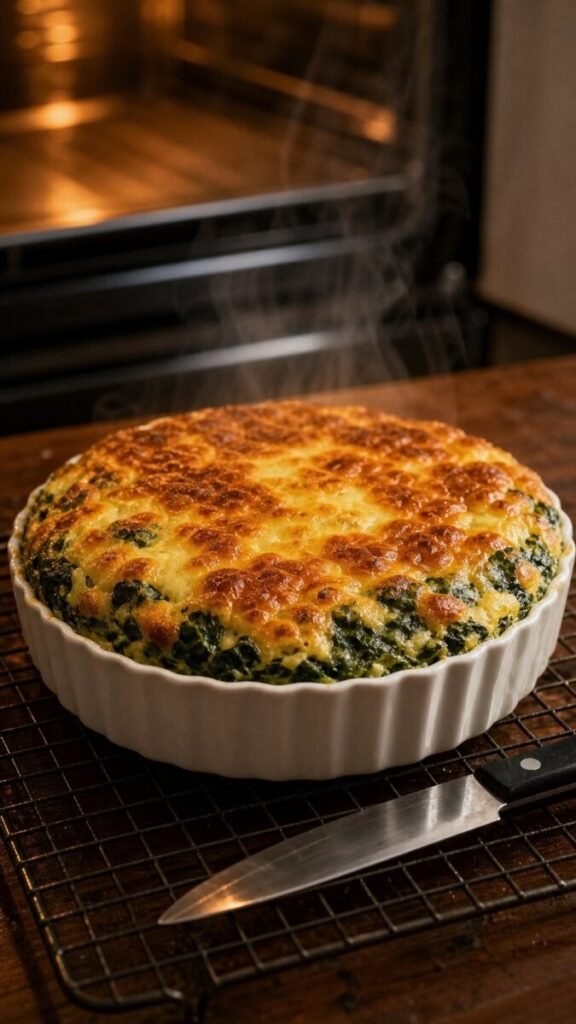
- Step 5 — The rest. Ten to fifteen minutes on a wire rack before the first cut. This is not etiquette; it’s engineering. The custard’s set finishes and tightens as it comes down, and a warm quiche sliced too soon runs where a rested one slices. Run the thin knife around the edge first, then cut into six. The first slice is always the raggedy one — that’s physics, not failure — so plate it for the cook and move on.
- Step 6 — Serve whenever brunch happens. Here’s the quiet superpower: this quiche is good warm, and it is arguably better at room temperature, where the custard firms to its cleanest texture and the flavors open up. That two-hour serving window is why quiche became brunch food in the first place — it bakes at ten and feeds people at eleven-thirty without complaint. Set it out with hot sauce and good salt for the top, a simple salad if you’re feeling virtuous, and take the compliments at whatever pace they arrive.
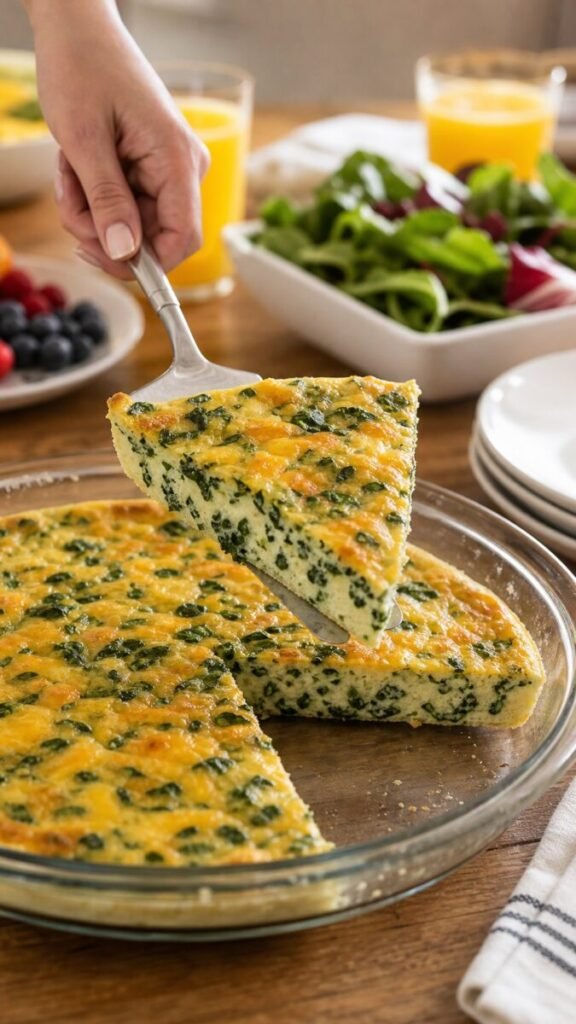
Same tub, different shift — this quiche is the savory half of the cottage cheese brunch program, and the 3-ingredient cottage cheese pancakes are the sweet half. One grocery store run, two brunches.
Anna’s Kitchen Notes
Small curd, real fat. Small-curd cottage cheese blends smoothest, and full-fat or 2% is the whole texture story — fat-free replaces fat with water, and the custard spends the bake slowly becoming the puddle you avoided. The blender makes curd size mostly moot, but small curd gets there fastest and with the least scraping. Buy the tub, not the whipped tub with the weird margins of the lid.
The garlic powder confession. I cook with fresh garlic everywhere else on this site, and in a delicate baked custard, powder genuinely wins: it disperses evenly through the blend instead of clumping into hot little pockets, and it skips the cutting board and knife entirely, which is the entire spirit of this recipe. Minced fresh works — use one small clove — but this is the one place in my kitchen where the powder is a decision, not a shortcut.
Nutmeg is doing more than it looks like. A quarter teaspoon of nutmeg in a spinach-and-egg dish is one of the oldest pairings in European cooking — spinach and eggs are both faintly mineral, and nutmeg bridges them with something warm that nobody quite identifies until you tell them. Fresh-grated from a whole nutmeg is noticeably better, and a whole nutmeg keeps for years in the spice drawer, quietly outliving every trend it witnesses.
The squeeze, one more time. A thawed ten-ounce block of spinach holds nearly half a cup of water, and half a cup of water under your custard is the difference between “how did you make this” and “why is there a puddle.” Twist the towel hard, feel the spinach go dry and dense, and if the idea of wringing greens bothers you, pour the green water on a houseplant and call it the circle of life.
Make it the night before. Pour the assembled quiche into the buttered dish, cover, and refrigerate overnight; bake it straight from the fridge in the morning with five to ten extra minutes. Cold custard bakes up just as well as room-temperature custard, and the version where you do nothing at 9 a.m. but turn on the oven and pour the coffee is the effortless brunch this title promised.
The Sunday Table
A brunch table wants one sweet thing, one potato thing, and a few things that crunch. The sweet slot: the McGriddle breakfast bake, which bakes on the same schedule this one does. The potato slot: the Irish cheddar hash brown skillet, crispy-edged and cheese-topped. For the crunch and the fresh, the air fryer carrot bacon is the smoky little strips people eat standing up.
And for the make-ahead wing of the table, the vegetarian zucchini slice is this quiche’s cousin from Down Under — same eggs-and-vegetables-in-a-dish energy, different accent — while the mango chia pudding sits in the fridge from last night and rounds out the spread with something bright. One oven, one skillet, one fridge, and a table that looks like it took all morning.
Same Bake, Other Fillings
The everything-bagel build. Stir 1½ teaspoons of everything-bagel seasoning into the custard and press a little more into the cheese on top, double the scallions, and serve with cream cheese whipped with a spoon of the custard’s own tang — sour cream. Tastes like an everything bagel that went back to school.
Broccoli and cheddar, the classic. A cup of finely chopped frozen broccoli, thawed and squeezed exactly like the spinach, folded in with the cheddar. It’s the flavor pairing every kid in America already trusts, now in a format that carries them to lunch.
Sun-dried tomato and basil. A third of a cup of oil-packed sun-dried tomatoes, blotted and chopped, and a handful of torn basil folded in at the end. The custard goes faintly pink and the whole thing reads far fancier than the effort involved, which is the brunch version of a hole in one.
Mushroom and Swiss. Eight ounces of mushrooms, sliced and sautéed until their water is gone, with a cup of Swiss instead of cheddar. This is the one variation that breaks the no-skillet rule, and it’s worth it — mushrooms that skip the sear bring their water to the custard instead, and we’ve spent this whole page evicting water.
The fridge clean-out. Any leftover cooked vegetable, blotted dry and up to a cup and a half of it, with whatever cheese needs using. Roasted peppers, caramelized onions, the last scoop of artichoke dip — this custard is a vehicle before it’s anything else, and brunch is a state of mind.
The skillet frittata conversion, honestly rated. Same custard, poured into an oiled skillet and finished on the stove top with a lid for eight minutes. It’s faster and dirties a different pan, but the texture turns firmer and more eggy — a frittata, honestly, and a good one. About eighty percent of the quiche experience on half the clock. Weekdays are allowed.
The Protein Receipt
| Nutrient | Per Slice (1 of 6) |
|---|---|
| Calories | 235 kcal |
| Protein | 19 g |
| Carbohydrates | 5 g |
| Fats | 16 g |
Estimates for the quiche as written, butter and cheddar included. The comparison is the reason this recipe exists: a classic crusted quiche slice with cream runs four hundred-plus calories with half the protein and a pastry’s worth of carbs on the side. This one lands at 235 with nineteen grams of protein and five grams of carbohydrate — numbers that belong to a protein bar wearing a brunch dress. The fats come from the cheddar, the eggs, and a modest amount in the cottage cheese, which is to say the tasty section of the ledger. Two slices with a salad is a lunch that carries you to dinner, and I’ve watched it happen at my own table on more than one Sunday.
The Overnight Plan
The make-ahead versions, best to boldest: assemble and refrigerate the night before, then bake from cold with five to ten extra minutes — the version for hosting without a single morning task left. Baked and refrigerated, it keeps four days, and a single slice reheats in thirty seconds in the microwave or, better, ten minutes in a 300°F oven while the coffee brews. Baked slices also freeze well for two months, wrapped tight; thaw overnight and warm gently, and the texture comes back remarkably whole.
The serving window deserves its own paragraph because it’s the brunch cheat code: this quiche is genuinely good for about two hours at room temperature, and many people, me included, think it’s at its best at hour one, when the custard is fully set and the flavors have opened. You can bake at ten for an eleven-thirty table, and the dish will not make you pay for it. A recipe that forgives your schedule is worth making twice as often, and this one ends up on my table most weekends for exactly that reason.
Leftover careers, because six slices rarely end at brunch: a cold wedge straight from the fridge is a legitimately great lunch; a warm slice over a salad turns the salad into dinner; and a slab between two pieces of toast with hot sauce is the breakfast sandwich nobody planned but everybody finishes. Few dishes this effortless come with a portfolio this full.
Where It Goes Wrong
A puddle under the slice. Wet spinach, almost always — the block wasn’t squeezed, or fresh spinach went in raw. Second suspect: fat-free cottage cheese, which weeps in the oven the way it weeps on the plate. The fix is the same as the prevention: twist the towel until the spinach is dry and dense, and buy dairy with actual fat in it. The puddle isn’t a baking failure; it’s an ingredient that was never asked to leave its water at the door.
Weeping, rubbery slices. Overbaked, full stop. Egg proteins that set too long squeeze out their moisture — syneresis, the technical name for the wet, grainy, springy slice every cafeteria has served at some point. Pull the quiche at the wobble and let carryover heat finish the center; the difference between silky and rubbery is a few minutes, and the oven timer is not the doneness signal — the shimmy is.
A pale, wet-looking top. The cheese all went into the interior, so nothing browned. The top layer of cheddar isn’t garnish; it’s the crust, and the Maillard browning on it is a good share of the flavor. If you’re already past baking and the top is pale, two minutes under the broiler, watched like a hawk, paints it gold — but next time, hold back the half cup for the top.
Stuck to the dish. Under-buttered, or cut before the knife went around the edge. Glass and ceramic hold a custard’s edges tight, and the first slice takes the brunt of it. Butter generously, run the thin knife around the rim the moment it leaves the oven, and accept that the first slice is the sacrifice that releases its five smoother siblings.
Grainy, dry curd-texture. Either the blender was skipped — leaving curds to seize into distinct pockets, rustic and a little chalky — or the oven ran hot. The blend is the texture of this dish; forty-five seconds is the whole ask. And if your oven runs high, drop to 325°F and add ten minutes, because custard would rather be slow-cooked than scorched, and so would you.
A flavorless quiche that looks perfect. Under-salt, and it’s sneaky here: cottage cheese and eggs both carry their salt dissolved and quiet, and the cheddar’s salt is busy being cheese. The written three-quarters of a teaspoon is calibrated for this exact ingredient list; if you swap cheeses or add vegetables, taste and adjust before pouring. And check the nutmeg — its absence is the most common note in my “something missing” mail.
Quiche Questions
Can I use fresh spinach instead of frozen?
Yes — use a full pound, wilted in a dry hot pan until it collapses, cooled, and squeezed exactly as hard. But frozen is the effortless default for a reason: it’s blanched at the plant, so it’s pre-cooked and concentrated before it ever reaches your freezer, and the block thaws in five minutes under warm water. A pound of fresh cooks down to what the ten-ounce block already is. Save the fresh spinach for salads and let the freezer do this work.
Can I use ricotta instead of cottage cheese?
As a close stand-in, yes — same amount, same blend, and a milder, less tangy result with a little less protein. The custard sets almost as sturdy. Ricotta’s texture is smoother to begin with, so the blend is shorter. What you lose is the tang that cottage cheese brings to the background of every bite, and a few grams of protein — I’d make the swap happily in a pinch, and keep cottage as the house standard.
How do I know exactly when it’s done?
Three signals, and you want all three: the edges are puffed and firmly set, the top is deeply golden, and the center shimmies like jello when you nudge the dish — set, but with a slight wobble, never sloshy. A thin knife inserted one inch from the edge should come out clean. Pull it at that wobble even if the timer disagrees; the carryover heat on the counter finishes the center, and every minute past the wobble starts trading silk for rubber.
Can I bake it in a different pan?
The custard fits a 9-inch pie dish, an 8×8 square, or a 9×5 loaf pan — the loaf makes thicker slices and wants about ten extra minutes. The brunch-tray move is muffin tins: the same custard divided into twelve greased cups bakes in 22 to 25 minutes at the same temperature, and mini crustless quiches are the first thing gone at any potluck. Check them early; small custards overbake fast.
Can I make it the night before?
Yes, two ways: assemble in the buttered dish, cover, refrigerate, and bake from cold with five to ten extra minutes — the relaxed-host version. Or bake it entirely the day before and serve it at room temperature, which this custard genuinely supports. The only version I avoid is par-baking: a half-baked quiche reheated to finish comes out between textures, and this recipe is too short to need tricks.
Is there a dairy-free version?
This recipe is structurally dairy — the cottage cheese is the whole engine — so the honest answer is a different recipe: silken tofu blended with the eggs (or aquafaba for a fully vegan build), nutritional yeast for the savory depth, and the same spinach, scallions, and seasonings. It lands around eighty percent of the experience and one hundred percent of the brunch utility. Worth making if the table needs it; not the same dish, and I won’t pretend otherwise.
Why cottage cheese instead of cream or milk?
Three reasons, and they compound: protein, tang, and structure. Cream brings fat and water; cottage cheese brings protein that co-sets with the eggs, a gentle tang that makes the custard taste more awake, and a body that slices without a crust. The side effects are the nutrition numbers — nineteen grams of protein and 235 calories a slice against four hundred-plus for a classic cream-and-crust version — and a blender step that takes forty-five seconds. The dairy case’s most valuable player, playing out of position.
No pastry · Smooth blended custard · Simple brunch
Cottage Cheese and Spinach Crustless Quiche for Effortless Brunch
Cottage cheese and eggs blended into a smooth custard, folded with well-drained spinach, scallions, and sharp cheddar. Baked without a crust and finished with a golden cheese topping for an easy, sliceable brunch centerpiece.
As an Amazon Associate I earn from qualifying purchases.
Ingredients
The smooth custard
- 16 oz small-curd cottage cheese, full-fat or 2%
- 5 large eggs
- 1 cup shredded sharp cheddar, divided — ½ cup for the filling and ½ cup for topping
The spinach & scallions
- 1 package (10 oz) frozen chopped spinach, thawed and squeezed very dry
- 3 scallions, thinly sliced
The seasoning & butter
- ½ teaspoon garlic powder
- ¼ teaspoon nutmeg, freshly grated if desired
- Up to ¾ teaspoon salt, depending on the saltiness of your cheeses
- ½ teaspoon black pepper
- 1 tablespoon butter, for greasing the dish
The brunch kit
- Blender or food processor
- Deep 9-inch pie dish or 8 × 8-inch baking pan
- Clean kitchen towel, for squeezing spinach
- Mixing bowl
- Flexible spatula
- Cheese grater
- Instant-read food thermometer
- Thin-bladed knife and pie server
- Wire cooling rack
Give the filling room: shallow pie plates vary in capacity. Use a deep dish with space below the rim, or choose the 8 × 8-inch pan. Do not overfill; bake any excess separately in a small buttered oven-safe dish.
Dry spinach, tender custard: squeeze the spinach firmly and break up the compressed clumps before folding it in. Remove the quiche once the center is safely cooked rather than baking longer just to darken the cheese.
Vegetarian check: choose cheeses made with vegetarian or microbial enzymes. This recipe contains eggs and dairy.
How to make it
-
Prepare the spinach and butter the dish
Heat the oven to 350°F with a rack in the center. Thaw the spinach in the refrigerator or use the package’s microwave instructions. Follow any package requirement to cook it before use, then cool until safe to handle. Wrap in a clean towel and squeeze firmly until very dry. Break apart the spinach clumps. Generously butter the bottom and sides of a deep 9-inch pie dish or 8 × 8-inch pan.
-
Blend the cottage cheese and eggs
Put the cottage cheese, eggs, garlic powder, nutmeg, salt, and pepper in the blender. Use less than the full salt amount if your cottage cheese and cheddar are particularly salty. Blend for about 45 seconds, scrape down the sides, and blend briefly again until smooth. Do not taste the raw egg mixture.
-
Fold in the greens and add the cheese topping
Pour the blended custard into a mixing bowl. Fold in the squeezed spinach, scallions, and ½ cup cheddar until evenly distributed. Transfer to the buttered dish, leaving space below the rim. Smooth the surface and scatter the remaining ½ cup cheddar evenly over the top.
-
Bake until the center is safely set
Bake for about 40–50 minutes, beginning to check near 40 minutes. The edges should be set, the top lightly golden, and the center no longer liquid. A slight, set-custard jiggle is fine, but confirm that the center reaches 160°F with an instant-read thermometer before removing it. Pan depth and material may change the timing. If the top browns too quickly, loosely shield it with foil. Do not rely on an edge-only knife test or carryover heat to finish an undercooked center.
-
Rest before cutting
Set the hot dish on a dry, heat-safe cooling rack and rest for 10–15 minutes. This allows the custard to settle and makes the slices easier to lift. Run a thin knife gently around the edge, then cut into six portions and lift with a pie server. The first slice may be less tidy than the rest.
-
Bring to the brunch table
Serve warm or after a brief cooling period. Keep track of the time out of refrigeration or hot holding, including the resting period. Refrigerate leftovers within 2 hours, or within 1 hour if the room or outdoor temperature is above 90°F.
Bakeware safety: do not place a refrigerator-cold glass or ceramic dish into a hot oven unless its manufacturer explicitly permits it. Follow the dish’s thermal-shock guidance. A pale cheese topping is fine; glass bakeware must not go under a broiler, and ceramic requires specific broiler approval.