

Easy Vegan Leek and Mushroom Goulash Recipe
Goulash began with herdsmen, not housewives. Hungarian shepherds — gulyás is literally the word for one — cooked this over open fires in a bogrács, a kettle hanging from a tripod, paprika-stained broth bubbling away while the sheep made their own plans. Somewhere in the last few centuries their campfire stew became the country’s national dish, and somewhere in the last century it traveled the world and mutated: what most of America calls goulash, the macaroni-and-ground-beef skillet, is a delicious cousin but a different animal entirely. This recipe reaches back toward the original — a paprika-forward pot, thick enough to coat a spoon, with vegetables in every bite — and makes one big change: the meat is gone, and mushrooms and leeks have taken its seat by the fire.
Taking meat out of a stew is not a small thing, and I want to be honest about what actually leaves the pot. You lose the browned crust that browning builds on beef, the collagen that melts into silk over a long simmer, and the deep savor that meat carries without trying. So this version rebuilds all three, deliberately: mushrooms seared hard in batches until they’re crusted and meaty, dried porcini and their soaking liquid for a depth that punches far above their price tag, tomato paste toasted until it smells like the bottom of a good pan, and a raw grated potato stirred into the broth, whose starch turns the pot glossy the way collagen turns it silky. The leeks do the quiet work onions usually do, but sweeter — they melt into the background and hold everything together.
Two rules before you start, because they carry this recipe. First: the paprika never touches a hot pan. It goes in off the heat, blooms for thirty seconds in the residual warmth, and then the liquid goes in — paprika scorches almost instantly over direct heat and turns the whole pot bitter, and there is no fixing it after. Second: sear the mushrooms in batches. Crowded mushrooms steam instead of brown, and the crust is the meatiness. The whole thing takes about an hour and a half, most of it hands-off, and like every stew worth its salt it’s better on day two — so consider making it a day before you actually need it, and take the compliment casually when it lands.
The Shepherd’s Pot
A quick word on what goulash is, because the word stretches across a spectrum. In Hungary, gulyásleves is a brothy paprika soup; pörkölt is the thicker, spoon-coating stew most of the world pictures; paprikás is the same idea finished with sour cream. This recipe lives at the thick end of that range — a stew, not a soup — with the classic spine intact: sweet paprika in serious quantity (two full tablespoons, not a shy sprinkle), caraway and marjoram in supporting roles, and potatoes and carrots cooked right in the pot as the shepherds did, not served alongside. The sour cream finish translates to a swirl of cashew cream or vegan sour cream, and I’d argue the lemony tang it brings does the same job the original does: it cuts the deep, almost sweet paprika broth and keeps the whole bowl awake.
The American version deserves its own sentence, mostly so we can all stop pretending to be confused. It arrived with immigrants, met a casserole culture, gained elbow macaroni and ground beef, and became a weeknight classic in its own right — it’s good, it’s just not this. If that’s the pot you grew up on, the variations section has a detour that folds macaroni into this vegan base, and it is dangerously close to the canned-soup memory of childhood. Food history is messy; dinner doesn’t have to be.
The Meatless Heavyweight
So how does a vegan pot get deep? The same way a meat one does — you just have to source the pieces by hand. A beef stew gets its savor from browning the meat and from hours of protein breaking down into glutamates, the compounds behind that savory, can’t-stop-eating-it quality. A plant-based pot has to bring its own glutamates to the party, and this one stacks four of them: dried porcini (mushrooms are the most concentrated natural source there is, and drying multiplies it), fresh mushrooms seared until genuinely browned (the Maillard reaction creates its own savor), tomato paste toasted past brick-red (heat concentrates its glutamates further), and a spoonful of soy sauce, which is essentially liquid savor with a passport. None of them alone tastes like beef. Together, layered at the right moments, they build the same deep floor that makes a stew taste like it simmered all day — because this one actually did simmer, and the flavors had time to meet each other.
Then the paprika, which deserves its own paragraph because it is the dish. Paprika’s color and aroma live in fat-soluble compounds, which is why Hungarian cooks stir it into lard or oil and why it blooms so beautifully here in the oil left from the mushrooms and leeks. But those same compounds are fragile: over direct heat, paprika goes from fragrant to bitter in seconds flat, with no warning and no mercy. Hence the off-the-heat rule — the pot comes off the burner, the paprika goes in, thirty seconds of stirring while it turns the oil sunset-orange, and only then does the liquid follow. That brief, gentle bloom is the difference between a pot that tastes of paprika and a pot that tastes of paprika’s funeral. The smoked paprika in the mix is doing something sneakier: it whispers of a wood fire the pot never saw, a stand-in for the bogrács smoke of the original.
Last piece: the body. Collagen is what makes a meat stew coat the spoon and cling to whatever it lands on, and plants simply don’t have it. The fix here is a potato grated on the large holes of a box grater, straight into the simmering pot — it breaks down completely within twenty minutes and releases its starch into the broth, which turns glossy and just thick enough. It’s the same trick my grandmother used to thicken soups when nobody was watching, it happens to be gluten-free, and unlike a flour slurry it can’t go lumpy, because the potato is already part of the pot. A stew that coats the spoon reads as rich; now you know the whole trick behind the reading.
⏱️ 1 HR 25 MIN | 🍲 6 BOWLS | 🌶️ PAPRIKA OFF THE HEAT
- Prep Time: 25 minutes — the porcini soak runs inside it
- Cook Time: 60 minutes, mostly simmering
- Total Time: about 1 hour 25 minutes
- Yield: 6 generous bowls
One Pot, Nothing Fancy
The equipment list is short, which is the whole point of shepherd food:
- Dutch oven or heavy pot, 5 to 6 quarts — wide enough to sear mushrooms in two batches without sulking.
- Fine-mesh strainer and a paper towel — for straining the porcini bath. Non-negotiable; see the grit note below.
- Box grater — the body of the stew depends on it.
- Wooden spoon — for scraping up the browned bits; they’re flavor, not mess.
- Ladle — six bowls means six confident scoops.
- Cutting board and a big knife — mushroom slicing is the main event of the prep.
Ingredients (With Labels)
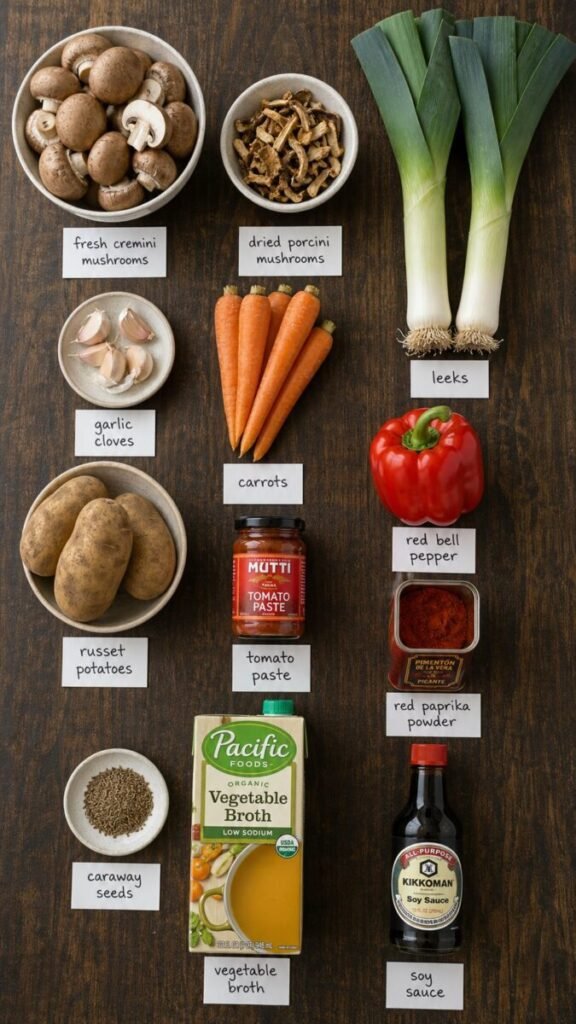
🍄 The Mushrooms and Their Bath
- Cremini mushrooms: 1½ lb — quartered or halved depending on size
- Dried porcini: ½ oz (one small bag)
- Warm water: 2 cups, for the bath
- Soy sauce or tamari: 1 tablespoon
🥕 The Pot Base
- Leeks: 2 large, white and light green parts, sliced
- Garlic: 4 cloves, minced
- Carrots: 2, cut into thick coins
- Red bell pepper: 1, cut into strips
- Potatoes: 1½ lb — 1 lb cubed, ½ lb reserved for grating
- Olive oil: 2 tablespoons
- Tomato paste: 2 tablespoons
- Crushed tomatoes: one 14-oz can
- Vegetable broth: 3 cups
- Bay leaf: 1
🌶️ The Spice Shelf
- Sweet paprika: 2 tablespoons — Hungarian if you can find it
- Smoked paprika: 1 teaspoon
- Caraway seeds: ¾ teaspoon, lightly crushed
- Dried marjoram: ½ teaspoon
- Black pepper and salt: ½ teaspoon pepper, about 1 teaspoon salt, adjusted at the end
🏁 The Finish
- Apple cider vinegar: 1 teaspoon
- Cashew cream or vegan sour cream: ½ cup, for swirling
- Fresh dill and flat-leaf parsley: a handful of each, chopped
- Warm naan or crusty bread: for the bowl’s other half
Step by Step How to Make
- Step 1 — Start the bath. Put the dried porcini in a bowl and pour 2 cups of warm water over them. That’s it — they need 25 minutes to soften and to give up their color, and those 25 minutes are exactly the time the prep takes, which is the kind of scheduling coincidence I refuse to call luck. While they soak, slice the mushrooms, wash the leeks, and prep the carrots, pepper, and potatoes.
- Step 2 — Sear in batches. Heat the Dutch oven over medium-high with 1 tablespoon of the oil until it shimmers. Add half the mushrooms in one uncrowded layer and then — this is the hard part — don’t touch them for 3 to 4 minutes. Let them brown properly, then flip in sections and give them 3 minutes more, until they’re crusted and have visibly shrunk. Out to a bowl, second batch with the remaining oil, same drill. No salt yet: salt pulls their water out before the browning can happen, and wet mushrooms steam gray. Mushrooms are introverts — crowd them or rush them and they sulk.
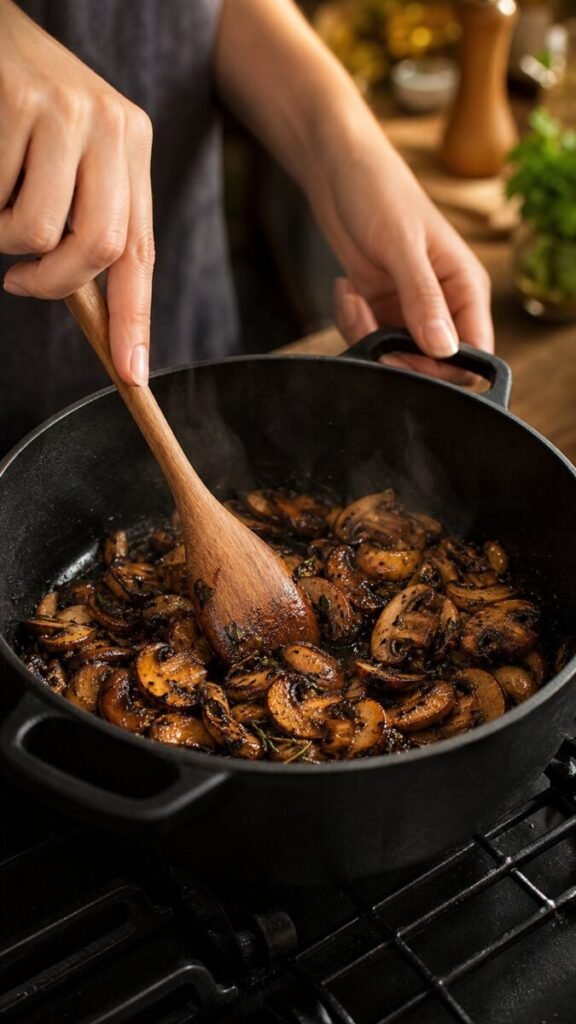
- Step 3 — Melt the leeks. Same pot, heat down to medium-low. Add the leeks with a pinch of salt and let them go slowly for 8 to 10 minutes, stirring now and then, until they’ve gone completely soft and sweet and translucent — melted, not browned. Add the garlic for 1 minute, then the tomato paste, and stir it around the pot for a full 2 minutes until it darkens to brick red and smells rusty and rich. This toasting matters; raw tomato paste tastes like a can, and toasted tomato paste tastes like the foundation of a stew.
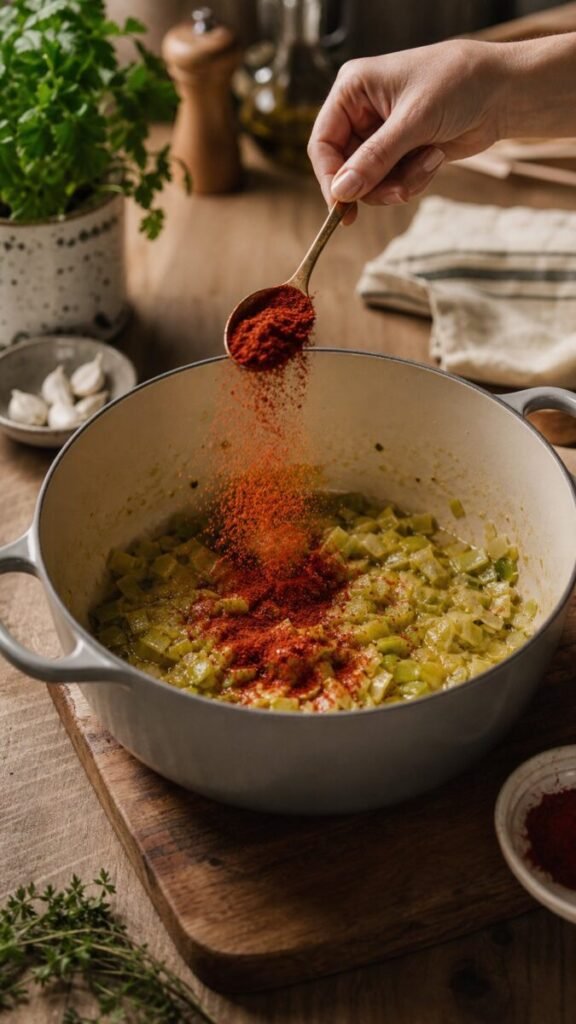
- Step 4 — Paprika, off the heat. Take the pot off the burner entirely. Stir in the sweet paprika, smoked paprika, caraway, marjoram, and black pepper, and keep stirring for 30 seconds as the residual heat blooms them and the oil turns sunset-orange. Back on medium heat, and pour in the strained porcini bath and the broth, scraping the bottom of the pot as you pour — that browned film is pure flavor and it wants rescuing. Add the crushed tomatoes, soy sauce, bay leaf, carrots, bell pepper, cubed potatoes, the seared mushrooms, and the rehydrated porcini (chopped if they’re large, rinsed well). Grate the reserved raw potato straight into the pot on the large holes of the box grater. Bring to a simmer, partially cover, and let it go for 35 minutes, stirring occasionally.
- Step 5 — The body check. At 35 minutes the potatoes should be tender and the broth noticeably glossy — that’s the grated potato’s starch at work, and it will thicken a little more as it sits. Taste, and I mean really taste: it wants salt (start with a teaspoon and climb), possibly another pinch of paprika, and it should taste deep rather than flat. If it tastes thin, simmer 10 minutes uncovered; if it tastes flat rather than thin, it’s usually salt it wants, not time.
- Step 6 — Finish and rest. Off the heat. Stir in the vinegar — it brightens the whole pot in a way you’ll notice the second it’s in — and let the pot rest for 10 minutes, lid on. The rest is a real step: the temperature settles, the starch finishes its work, and the flavors stop being a group of ingredients and start being goulash. Serve in wide bowls with a swirl of cashew cream, the dill and parsley scattered over, and warm naan for the edges of the bowl. The shepherds had a tripod and a fire; you have a Dutch oven and a ladle. Same stew.

Deep, glossy, and quietly good for you — this pot pairs with the vegan no-yeast naan bread the way stew and bread have paired since the first kettle hung over a fire: seriously.
Anna’s Kitchen Notes
Buy the porcini once, eat them forever. A small bag of dried porcini costs less than a fancy coffee, lives happily in the freezer for a year, and its soaking liquid is the closest thing a vegan kitchen has to a shortcut to deep. This recipe uses half an ounce; the rest of the bag waits for the next pot, and there will be a next pot. If the grocery store doesn’t carry them, any dried mushroom mix works — porcini just brings the most depth per pinch.
Launder the leeks properly. Leeks grow in sandy soil and they farm that dirt the way my aunt farms gossip — industrially, and into every layer. Halve them lengthwise, fan the layers under running water, then slice. Or slice first and swim them in a bowl of water, lifting them out with your hands and leaving the sand behind on the bottom. Either way, a gritty goulash is a sad goulash, and it was entirely preventable.
The sear is not optional. Mushrooms have no fat to render and no collagen to melt — the crust you build in the pan is the entire meatiness they’ll ever have. Skipping it doesn’t save time so much as save the mushrooms for a pot that tastes like warm vegetable water. Two batches, high heat, patience: six extra minutes that carry the whole recipe.
The grated potato is the collagen stand-in. One raw potato, large holes, straight into the simmer. It vanishes completely and takes the broth from watery to glossy, no slurry, no lumps, no gluten. If you skip it, the pot will still taste right — it just won’t cling to the spoon or the bread, and half of what reads as “rich” is exactly that cling.
Make it a day early. Like every paprika pot in history, this one is better after a night in the fridge, when the flavors finish introducing themselves to each other. Sunday’s pot, Monday’s dinner, and the reheated version draws more compliments than the fresh one ever did. Reheat gently with a splash of broth and stir well — the body comes right back.
The Ladle Mates
The pot wants bread beside it and something cool on top. The creamy cashew cheese sauce is the stand-in for the sour cream Hungary finishes its stews with — loosened with a spoon of the broth, it swirls straight into the bowl. And when the whole table leans mushroom, the vegan paella with mixed mushrooms is the same love in a different accent — same main ingredient, completely different evening.
For a fuller spread, the mushroom spinach enchiladas keep the theme going for the cheese-eating wing of the family, the black bean and lentil soup makes the week’s lunch out of the same cozy mood, and the lentil quinoa patties are the protein-forward side this bowl politely asks for. One pot on the stove, one table, nobody asking where the meat went.
Same Pot, Other Gardens
The Midwest detour. Stir 8 oz of elbow macaroni into the pot for the last 8 minutes of simmering, with an extra cup of broth to feed it. Suddenly it’s the American goulash of cafeteria memory, vegan edition — one pot, total nostalgia, and a dangerous conversation to have with your inner eight-year-old.
Butter beans for bulk. A can of butter beans, drained and stirred in for the last 10 minutes, makes the pot rounder and more filling, and the beans soak up the paprika broth like they trained for it. This is the version to make when the table includes people who fear a meal without something they can point at.
The wine option. After the paprika blooms, pour in ½ cup of dry red wine and let it bubble for 2 minutes before the broth. It deepens the pot further — the classic European move — and the alcohol cooks off, leaving only the richness. Skip it entirely if you prefer; the porcini bath already did the heavy lifting.
Turn up the honest heat. Replace half the sweet paprika with hot paprika, or add a pinch of cayenne with the spices. Hungarian hot paprika is the traditional dial, and it turns the pot from cozy to lively without touching anything else in the recipe.
The root swap. Parsnips or celeriac in place of the carrots, and cubed sweet potato for half the potatoes — the pot shifts a season toward late autumn without changing its character. Root vegetables are forgiving like that; the paprika is the identity here, everything else is scenery.
The Tuesday version, honestly rated. No porcini, no batches — all the mushrooms in at once with the leeks, extra soy sauce, an extra tablespoon of tomato paste, 25-minute simmer. You lose the crust and the depth, and the pot lands at about seventy-five percent: still good, still better than delivery, and made in half the time. Tuesday is allowed, and Wednesday can have the real one.
The Bowl Ledger
| Nutrient | Per Bowl (1 of 6) |
|---|---|
| Calories | 240 kcal |
| Protein | 7 g |
| Carbohydrates | 30 g |
| Fats | 7 g |
Estimates for the pot as written, cashew cream swirl included. Two hundred forty calories for a bowl that eats like a restaurant stew is the quiet advantage of building depth with mushrooms instead of marbled beef — the sear and the paprika carry the richness, not the calorie count. The mushrooms bring a fair share of the protein along with the lentil-free pot’s other quiet gifts: fiber, potassium, and a genuinely respectable amount of B vitamins for something that tastes like a splurge. If you add the butter beans from the variations, the protein climbs to around ten grams a bowl, and the comfort climbs all by itself.
The Day-Two Pot
The fridge version is the whole point of making extra: three to four days covered, and the second-day bowl is the best one, deeper and rounder than the first night’s. The paprika settles, the porcini finishes its argument with the tomatoes, and the broth thickens a shade as the potato starch sits. Reheat gently with a splash of broth or water and stir well — the body re-forms as it warms, and a slow reheat on the stove beats the microwave for texture, though the microwave is allowed on a weeknight and I won’t tell.
The freezer holds this pot for three months. Cool it fully, freeze flat in freezer bags or in containers with headroom, and thaw overnight in the fridge before reheating. Potatoes sometimes go a little soft-hearted after freezing — if the cubes have lost their edges, stir the pot firmly and they become part of the body instead of a separate piece, which is a very Hungarian way of handling a setback.
Leftover careers, because this pot multiplies: over toast with a fried egg for the vegetarians who eat eggs (or scrambled tofu for those who don’t), spooned over a baked potato, folded into cooked pasta for a goulash-adjacent Wednesday, or thinned with broth and blended smooth into a velvety soup with a new identity. A recipe whose leftovers all have second careers is a recipe worth keeping, and this one earns its spot in the winter rotation every single year.
Where It Goes Wrong
A bitter, harsh pot. Scorched paprika — it went in over direct heat, or the pan was too hot when it landed. Paprika turns bitter in seconds and no amount of simmering walks it back. The rule is absolute: pot off the burner, spices in, thirty seconds, liquid in. If it’s already bitter, a pinch of sugar and a spoon of cashew cream will soften the blow, but the honest fix is prevention, and now you have the rule.
Gray, watery mushrooms. They were crowded, salted too early, or both. Crowded mushrooms steam in their own liquid instead of browning, and early salt pulls that liquid out before the crust forms. Give them space in two batches, leave them alone for the first few minutes, and salt the pot, not the pan. The color of the mushrooms in the finished pot tells you exactly how the sear went.
A thin, brothy pot. Three usual suspects: the sear was skipped, the grated potato was skipped, or the simmer ran short. The first two are the recipe’s whole architecture, so if they happened, mash a few of the cubed potatoes against the side of the pot and simmer ten minutes uncovered — the pot will pull itself together. If it’s still thin, a second half-potato grated in and ten more minutes finishes the job.
A gritty spoonful. Unstrained porcini liquid. The soaking water carries the flavor, and the last tablespoon carries the sand the mushrooms grew in. Strain the bath through a paper towel set in a strainer, and pour gently — the grit sits at the bottom of the soaking bowl, so the final splash can stay behind. Thirty seconds of care, zero grit.
A flat, “something missing” pot. Nine times out of ten it’s salt — plant-based pots need more than instinct suggests, because none of the ingredients arrive pre-salted the way meat does. The tenth time, it’s acid: a teaspoon of vinegar at the end wakes the whole pot. And if it’s deep but somehow quiet, another half-teaspoon of soy sauce usually closes the gap. Taste at every one of those gates and adjust before the lid goes on.
Sandy leeks. They skipped the bath. Leeks hide grit between their layers with real commitment, and no amount of simmering dissolves sand — it just redistributes it evenly, which is worse. Halve and rinse under running water, or slice and swim them in a bowl. This is the most boring paragraph in the recipe and the one that saves the most dinners.
Stew Questions
Can I skip the dried porcini?
You can — the Tuesday version in the variations exists for exactly that — but expect a lighter, more straightforward pot. To narrow the gap, add an extra tablespoon of tomato paste (toasted with the first one) and an extra tablespoon of soy sauce, and give the fresh mushrooms an especially hard sear. The dried porcini remain the single cheapest depth upgrade in the recipe, though, so if you can find them, they earn their bag.
Which fresh mushrooms are best here?
Cremini is the baseline and the budget hero — widely available, brown enough to sear well, and meaty in the pot. A mix of cremini with some shiitake and oyster mushrooms is even better, and portobello chunks work if that’s what’s on sale. Plain white buttons are the mildest of the lot; they’ll still be good, but the sear has to do all the talking. Whatever you buy, the batch-sear matters more than the variety — a fancy mushroom crowded into a wet pan is a wasted fancy mushroom.
Is Hungarian paprika really necessary?
It’s worth the jar, not the pilgrimage. Hungarian sweet paprika is brighter and fruitier than generic, and it’s the flavor this pot is built around — most spice aisles and every online store carry it. Regular sweet paprika will still make a good pot, and smoked paprika plus a pinch of cayenne covers some of the distance. What no paprika can survive is scorching, so wherever yours is from, the off-the-heat rule stays.
Can I make this in a slow cooker?
Yes, with one condition: sear the mushrooms and toast the tomato paste on the stove first, because a slow cooker cannot brown anything, and the crust is the recipe. After that, everything goes into the cooker — hold the grated potato back — on low for 7 to 8 hours. In the last hour, grate the potato in (the long gentle heat will still dissolve it) or mash a scoop of the solids against the wall. Finish with the vinegar and rest as written.
Is this recipe gluten-free?
The pot itself is naturally gluten-free — the body comes from potato starch, not flour. Two labels to check: use tamari instead of soy sauce, and confirm your vegetable broth is certified gluten-free, since some brands sneak wheat in. Serve over rice or with gluten-free bread, and the whole table eats the same dinner, which is my favorite kind of dinner.
How does it reheat?
Gently, and with a splash of broth or water in the pan — medium-low, stirring now and then, until it’s hot through and the gloss has come back. The body re-forms as it warms, so a pot that looks loose straight from the fridge thickens right up by the time it’s steaming. The microwave works in a pinch; cover the bowl and stir at the halfway mark. Day-two goulash is the reward for having made too much, which was always the plan.
How do I add more protein?
The butter-bean variation is the easiest lift — a can stirred in at the end takes each bowl to around ten grams. The lentil quinoa patties linked in the pairings make it a full protein plate on the side. Or a handful of red lentils simmered straight into the pot for the last 25 minutes — they vanish into the broth, thicken it further, and quietly raise the number while nobody’s watching.
Plant-based comfort · Browned mushrooms · Paprika-rich broth
Vegan Leek and Mushroom Goulash
A hearty Hungarian-inspired stew with deeply browned mushrooms, sweet leeks, dried porcini, potatoes, and plenty of sweet paprika. Grated potato thickens the broth, while a swirl of vegan cream and fresh herbs brightens each bowl.
As an Amazon Associate I earn from qualifying purchases.
Ingredients
The mushrooms & soaking liquid
- 1½ lb cremini mushrooms, cleaned, dried, and halved or quartered
- ½ oz dried porcini mushrooms
- 2 cups warm water, for soaking
- 1 tablespoon soy sauce or tamari
The vegetable base
- 2 large leeks, white and light green parts only, thoroughly washed and sliced
- 4 cloves garlic, minced
- 2 carrots, cut into thick coins
- 1 red bell pepper, cut into strips
- 1½ lb potatoes, peeled if desired — 1 lb cut into approximately ¾-inch cubes and ½ lb reserved for grating
- 2 tablespoons olive oil, divided, plus a little extra if the pot is dry
- 2 tablespoons tomato paste
- 1 can (14 oz) crushed tomatoes
- 3 cups vegetable broth
- 1 bay leaf
The paprika & spices
- 2 tablespoons sweet paprika, preferably Hungarian
- 1 teaspoon smoked paprika
- ¾ teaspoon caraway seeds, lightly crushed
- ½ teaspoon dried marjoram
- ½ teaspoon black pepper
- About 1 teaspoon salt in total, adjusted to taste
The creamy finish
- 1 teaspoon apple cider vinegar
- ½ cup prepared, unsweetened cashew cream or vegan sour cream
- 1 handful fresh dill, chopped
- 1 handful flat-leaf parsley, chopped
- Warm vegan naan or vegan crusty bread, for serving
The stew pot kit
- Wide 5–6-quart Dutch oven or heavy pot
- Heatproof bowl, for soaking porcini
- Fine-mesh strainer and a paper coffee filter, for filtering the soaking liquid
- Box grater
- Wooden spoon
- Ladle
- Chef’s knife and cutting board
Keep the grit out: wash between the leek layers, rinse the softened porcini, and filter their soaking liquid. Leave the last sediment-filled spoonful in the soaking bowl.
Protect the paprika: remove the pot from the burner and let fierce sizzling subside before adding the spices. Residual heat can still scorch paprika, so keep the broth ready and add it promptly after a brief stir.
Dietary checks: ordinary naan may contain dairy or egg. Choose vegan bread and toppings. For a gluten-free meal, use labeled gluten-free tamari, broth, toppings, and bread. Cashew cream contains tree nuts; soy sauce and most tamari contain soy.
How to make it
-
Soak the porcini and prepare the vegetables
Put the dried porcini in a bowl with 2 cups warm water and soak for about 25 minutes, or according to the package instructions. Meanwhile, prepare the fresh mushrooms and vegetables. Wash the leeks thoroughly between their layers, then drain. Lift out the softened porcini, rinse away any grit, and chop. Strain the soaking liquid through a coffee-filter-lined fine-mesh strainer, leaving sediment behind. Reserve the liquid.
-
Brown the fresh mushrooms in batches
Heat 1 tablespoon olive oil in the Dutch oven over medium-high heat. Add half the mushrooms in an uncrowded layer. Leave undisturbed for 3–4 minutes, then turn and cook for another 3 minutes or until well browned. Transfer to a bowl. Repeat with the remaining tablespoon of oil and mushrooms. Use additional smaller batches if your pot is narrow. Let released moisture evaporate so the mushrooms can brown.
-
Soften the leeks and toast the tomato paste
Reduce the heat to medium-low. Add the leeks and a pinch of the measured salt. If the pot is dry, add a little extra oil or a splash of the measured broth to prevent scorching. Cook for 8–10 minutes, stirring, until soft. Add the garlic and cook for 30–60 seconds. Stir in the tomato paste and cook for about 2 minutes, until it darkens slightly without burning.
-
Bloom the paprika off the heat and build the stew
Remove the pot from the heat and let strong sizzling subside. Stir in the sweet paprika, smoked paprika, caraway, marjoram, and black pepper for about 20–30 seconds. Immediately add the filtered porcini liquid and vegetable broth, scraping up the browned bits, then return to the heat. Add the crushed tomatoes, soy sauce or tamari, bay leaf, carrots, bell pepper, cubed potatoes, browned mushrooms, and chopped porcini. Coarsely grate the reserved ½ lb potato and stir it in without rinsing away its starch.
-
Simmer until tender and lightly thickened
Bring to a gentle simmer, partially cover, and cook for about 35 minutes, stirring occasionally and scraping the bottom to prevent sticking. Check that the carrots and potatoes are fully tender; the acidic tomato broth may make them take longer. Continue simmering as needed. If the stew is thinner than you prefer, uncover and simmer another 5–10 minutes, or mash a few potato cubes into the broth. Add a splash of water if it becomes too thick. Taste and gradually add the remaining salt as needed.
-
Finish with vinegar, rest, and garnish
Remove from the heat, discard the bay leaf, and stir in the apple cider vinegar. Cover and rest for 10 minutes. Taste once more, then ladle into six bowls. Divide the cashew cream or vegan sour cream among them and scatter with dill and parsley. Serve with warm vegan naan or crusty bread.
Texture check: the grated potato softens and releases starch, but it may not disappear completely. The stew should be spoonable and lightly thickened, not necessarily as dense as a flour-thickened gravy. Judge the vegetables by tenderness rather than the timer alone.