Hearty Southwest Black Bean Skillet Recipe
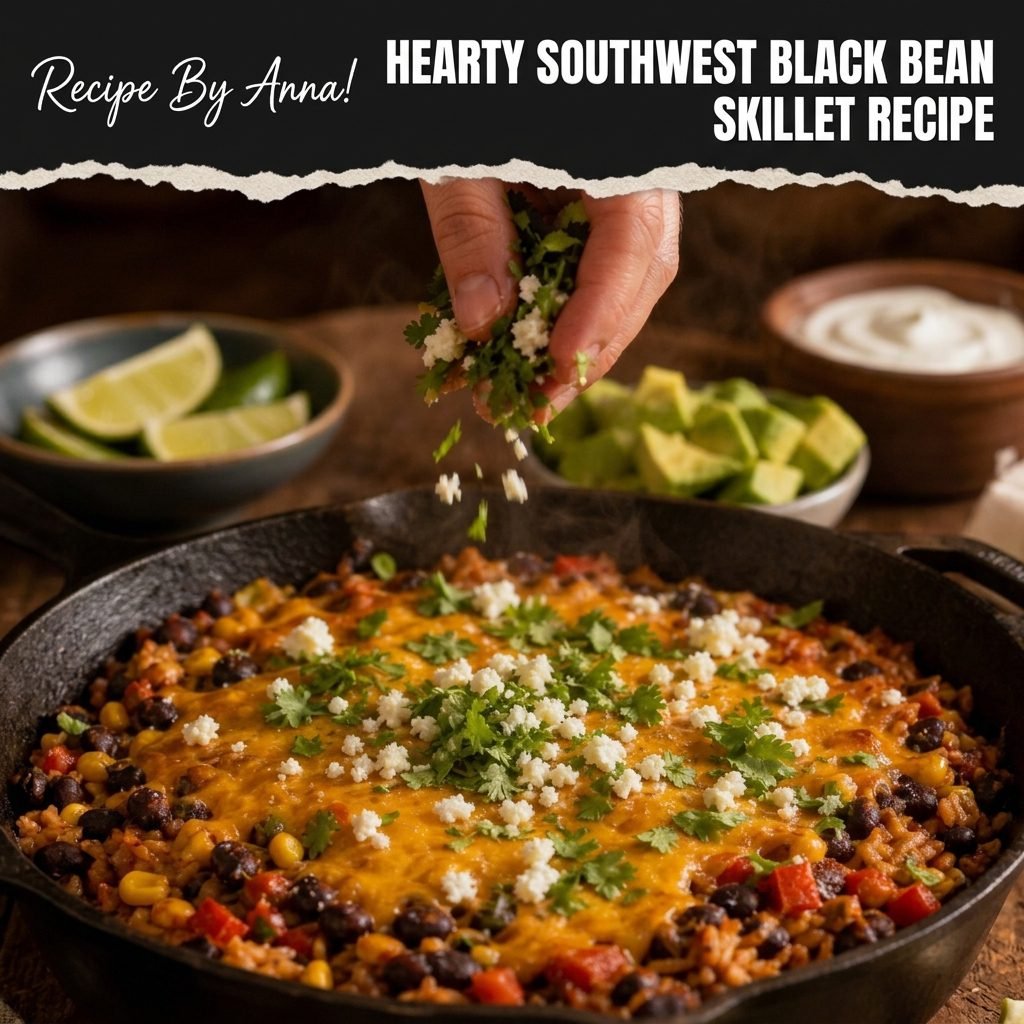
Some nights the only dinner plan I can manage is “everything goes in one pan and the pan goes on the table.” This hearty southwest black bean skillet is that plan at full power: onions, peppers, and garlic hit hot oil with chili powder, cumin, and smoked paprika until the kitchen smells like a taco stand, then fire-roasted tomatoes, broth, and rice join, the lid goes on, and the skillet does the rest. Black beans and corn fold in at the end, cheddar melts over the top under the lid for three minutes, and dinner — creamy, smoky, genuinely hearty — lands in about thirty-five minutes with one dish to wash after.
The thing that makes this version worth its pan space is that the rice cooks in the skillet, in the same seasoned broth as everything else. That’s the difference between a skillet dinner and a bunch of ingredients that happen to share a pan: every grain of rice drinks the chili-cumin-tomato liquid, so the flavor is cooked in rather than poured on top. The starch the rice releases along the way thickens the broth into something between a stew and a risotto, and the bottom of the pan — if you let it sit a minute off the heat — develops a lightly crisped layer that everyone at my table fights over like it’s the prize section.
A few honest notes before you start. This is a vegetarian dinner that eats like a meat one — the beans and the smokiness do that work together — but it converts instantly for carnivores (variations below). The lid is the most important tool in the recipe: on for the simmer, off for the finish, back on for the cheese. And the last-minute lime and cilantro are not garnish decisions, they’re the recipe’s brightness — the acid that keeps a rich tomato-rice skillet from sitting heavy. Skip them and you’ll feel like something’s missing, because it will be.
Why This Skillet Wins the Week
One-skillet rice dinners live or die on the liquid math, so let’s do the math out loud. Long-grain white rice needs roughly one and three-quarters cups of liquid per cup of rice when it cooks covered and undisturbed — and this recipe deliberately gives it more: a full can of fire-roasted tomatoes with its juice plus a cup of broth comes to about two and three-quarters cups, and the surplus is the point. The rice takes what it needs and the rest reduces into the glossy, lightly sauced finish that makes this a skillet dinner rather than a pot of rice. Too much liquid and you’ve made soup; too little and the rice stays chalky in the middle. Measured right, the rice finishes tender at the same moment the liquid reduces to a glossy coating, and nothing in the pan is an accident.
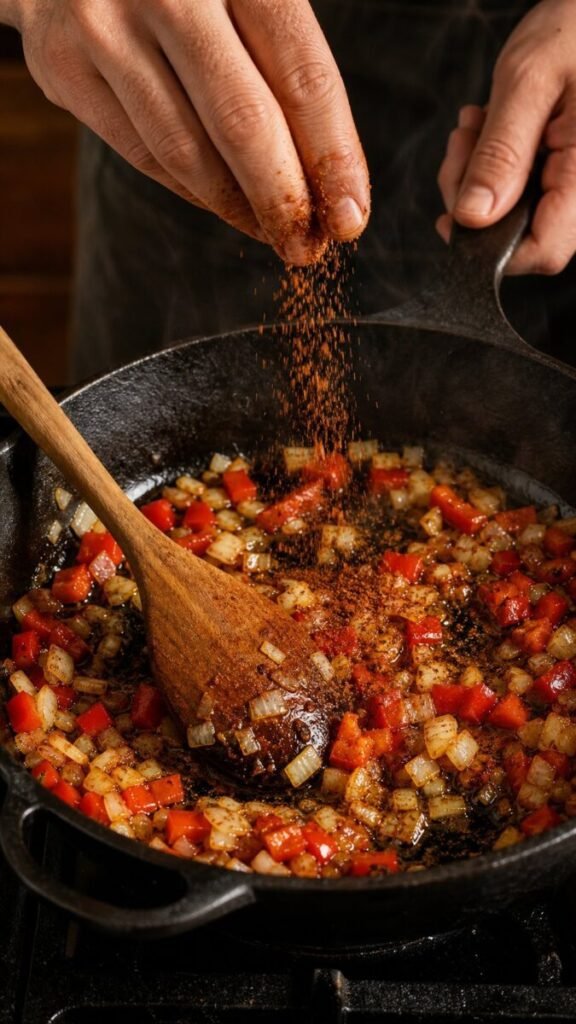
The spice bloom is the flavor foundation, and it happens in the first four minutes. Chili powder, cumin, and smoked paprika are oil-soluble — their flavor compounds wake up in hot fat in a way they never do in cold liquid. Bloom them in the oil with the onions for sixty seconds and the whole skillet inherits a depth that tastes like it simmered all day. Skip the bloom and dump the spices into the broth instead, and you’ll get a dinner that tastes like it was seasoned from a distance. Same spices, same amounts, completely different result — the pan is the difference.
Then there’s the beans-and-cream strategy. Black beans go in only for the last five minutes, because canned beans are already cooked and long simmering turns them to mush and dulls their color. Corn goes in at the same time for the same reason — its sugars are at their best with barely any cooking at all. And the cheddar lid, melted off the heat with the lid back on, turns the skillet’s surface into a self-saucing layer: every scoop drags strings of cheese up through the rice. It’s the difference between a bowl of food and a bowl of food people photograph.
⏱️ 35 MIN | 🌵 ONE SKILLET, ONE LID | 🧀 THE CHEDDAR LID
- Prep Time: 10 minutes
- Simmer Time: 18 minutes
- Finish Time: 8 minutes
- Total Time: 35 minutes
- Yield: 5 hearty bowls
The Skillet Kit
One pan, one lid, a few basics:
- Deep 12-inch skillet with lid — cast iron or heavy nonstick; deep enough to hold the simmer without spitting.
- Wooden spoon — for the bloom, the stir, and the scrape.
- Chef’s knife and cutting board — one onion, one pepper, that’s the knife work.
- Can opener — beans, tomatoes, chiles if you use them: this recipe runs on the pantry.
- Microplane or fine grater — optional, for a clove of garlic in five seconds.
- Ladle or big spoon — for serving straight from the pan at the table.
Ingredients (With Labels)

🌶️ The Base
- Olive oil: 2 tablespoons
- Onion: 1 medium, diced
- Red bell pepper: 1, diced
- Garlic: 3 cloves, minced
- Chili powder: 1 tablespoon
- Ground cumin: 2 teaspoons
- Smoked paprika: 1 teaspoon
- Dried oregano: ½ teaspoon
🍅 The Liquid and the Rice
- Fire-roasted crushed tomatoes: one 15-oz can, juice and all
- Vegetable broth: 1 cup
- Long-grain white rice: 1 cup, rinsed
- Salt and pepper: ½ teaspoon salt, ¼ teaspoon pepper
🫘 The Hearty Part
- Black beans: 2 cans (15 oz each), drained and rinsed
- Corn kernels: 1 cup — frozen straight from the bag is fine
🧀 The Lid and the Brightness
- Sharp cheddar: 1½ cups shredded
- Lime: 1, halved
- Cilantro: ¼ cup chopped
- Toppings to pass: avocado, sour cream, hot sauce, extra lime
Step by Step How to Make
- Step 1 — Bloom the base. Heat the oil in the skillet over medium. Add the onion and bell pepper and cook 3 to 4 minutes, until the onion turns translucent and the pepper’s edges soften. Add the garlic and all four spices, and stir constantly for 60 seconds — the spices will darken slightly and the pan will go fragrant enough to announce dinner to the whole house. This minute is the flavor foundation; nothing after it matters as much.
- Step 2 — Build the cooking liquid. Pour in the fire-roasted tomatoes with their juice and the broth, stirring and scraping the bottom of the pan clean — those browned spice bits are concentrated flavor and they dissolve right into the liquid. Season with the salt and pepper and bring the whole thing to a boil.
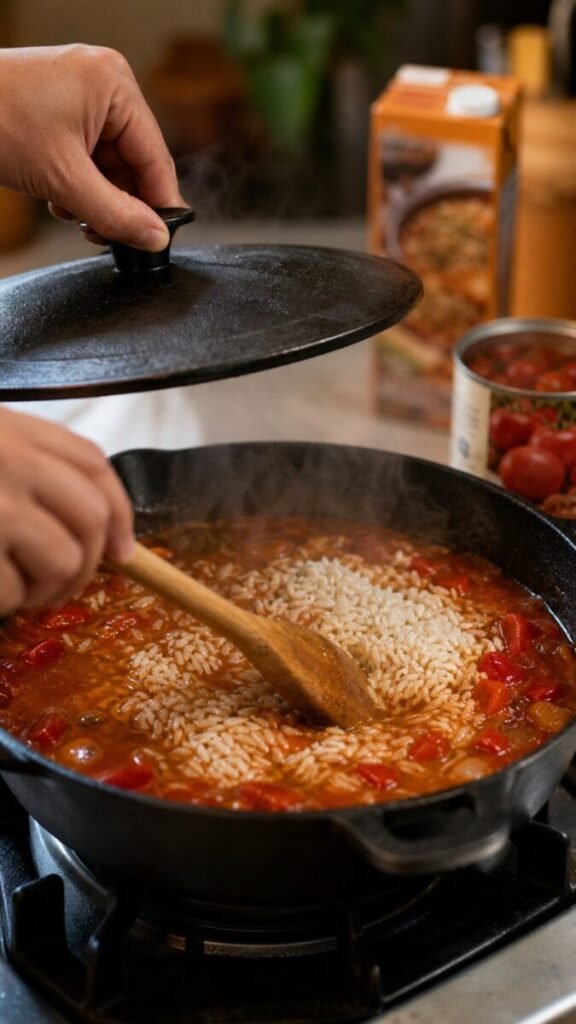
- Step 3 — Rice in, lid on, hands off. Stir the rinsed rice into the bubbling tomato broth, drop the heat to low, and clamp the lid on. Now the hardest instruction in the recipe: don’t stir for 18 minutes. Covered rice needs undisturbed steam to cook evenly, and every stir releases it. Set the timer, chop your cilantro, slice the avocado, put out the toppings — the skillet doesn’t need you until the timer does.
- Step 4 — Beans and corn, briefly. When the timer goes, lift the lid and check: the rice should be tender with the liquid mostly absorbed, and a few glossy pools still visible. Fold in the black beans and corn, put the lid back on, and give them 5 minutes over the same low heat — just enough to warm the beans through and cook the corn to bright and sweet. The beans will soften and darken if you cook them long, and they deserve better.
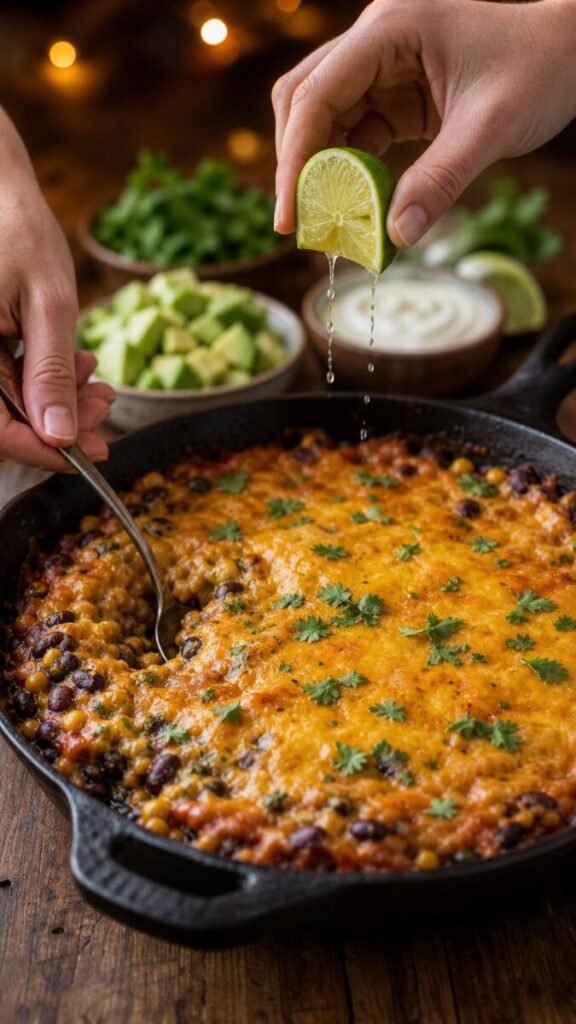
- Step 5 — The cheddar lid. Turn the heat off. Squeeze the juice of half the lime over the skillet and sprinkle the cilantro across the top, then blanket everything with the cheddar and put the lid back on for 3 minutes. The residual heat melts the cheese into a lid and the lime and cilantro steam their brightness up through the whole pan. No flame under the pan at this point — you’re finishing with stored heat, not cooking, and the rice at the bottom will thank you by not scorching.
- Step 6 — Skillet to table. Carry the pan out on a trivet with the lid still on, and lift it at the table — the reveal is steam, melted cheddar, and a table that suddenly has opinions. Serve in bowls straight from the skillet, with the remaining lime half, the toppings, and hot sauce going around. Correct topping procedure: avocado, a spoon of sour cream, a hit of lime, and then the first bite, which lands warm, smoky, creamy, and bright all at once.
One-pan Tex-Mex is a family tradition here — this skillet is the stovetop member, and the casserole-shaped sibling is our Walking Taco Casserole, for the nights the oven should do the work instead.
Anna’s Kitchen Notes
Cast iron or nonstick — both work, one warns you. Cast iron holds heat evenly and gives you that lightly crisped bottom layer that scoop-eaters fight over; nonstick gives you an easier cleanup and no crisped layer at all. Either way, the low simmer matters more than the pan material. What cast iron adds is that crust, and what nonstick adds is Tuesday-night peace of mind — I own both and use both, and the skillet has never once taken it personally.
Rinse the rice, trust the math. A quick rinse under the tap washes off surface starch that would otherwise make the grains gluey in a tomato broth. And hold the liquid amounts as written even when your instinct says the pan looks too dry at the 15-minute mark — rice in tomato broth looks less soupy than rice in water because the liquid hides in the sauce. Trust the ratio; it has never once let me down, and I’ve made this pan more times than I’ll admit on the internet.
Smoked paprika is the vegetarian’s smoke. The reason this dinner eats heartier than its ingredient list is the pairing of smoked paprika with cumin — it reads as “cooked over something” even though nothing was. If you have chipotle powder instead, use half the amount and the skillet goes smoky and warmly hot in one move. Regular sweet paprika works in a pinch but loses the depth, and the pan will taste like it’s wearing a costume.
The five-minute bean rule. Canned beans are cooked food, and treating them like raw ingredients is how they turn to mush. Rinse them well — the can liquid is starchy and salty and does your broth no favors — and give them exactly the last five minutes. They arrive warm, intact, and still distinct in the bowl, which is everything a bean wants from a skillet.
Double the toppings, not the recipe. The skillet scales up poorly — rice needs its liquid ratio respected and a crowded pan simmers unevenly — so when company’s coming, I make the pan as written and spend the effort on the toppings bar instead: two avocados, sour cream, pickled jalapeños, hot sauce, extra lime, and a bowl of tortilla chips for structural snacking. Nobody has ever counted the servings when the toppings table looks like that.
The Toppings Bar
The skillet is the main event; the sides are whatever’s crisp and cold. A Frito Corn Salad is the natural desk-mate — it shares the corn and the crunch and needs no cooking at all. Tortilla chips in a bowl cover the scooping faction, and they double as a delivery system straight from the pan when the bowls run low.
On rotation weeks, this pan trades shifts with the rest of the one-pot crew: Cozy Vegetarian Chili Mac is the pasta-shaped sibling with the same smoky-bean DNA, and the Veggie Rice Bake is its oven-baked cousin — between them, the “rice plus vegetables plus one pan” question stays answered all season.
Skillet Remixes
The sweet potato route. Dice a sweet potato small and add it with the broth, giving the simmer five extra minutes before the rice goes in — or roast cubes separately and fold them in with the beans. That version leans closer to our Sweet Potato & Black Bean Enchiladas, the rolled-up member of the same family, and it’s the one I make when October asks for it.
Chicken or sausage night. Brown a pound of diced chicken or sliced smoked sausage in the oil before the onions, then carry on — the fond from the meat upgrades the whole pan. The vegetarian version is my default, but the skillet doesn’t care either way, and the meat-eaters at the table stop asking questions.
The queso drizzle. Skip the cheddar lid and finish each bowl with a warm ladle of our Mexican White Cheese Dip instead. It’s the deluxe route, it takes twelve extra minutes, and it turns a Tuesday skillet into the thing people mention on the way out the door.
Breakfast skillet. Make the pan as written, then crack four eggs into wells in the surface, lid back on, five minutes on low — the whites set and the yolks turn the whole skillet into a runny-sauce situation. Cilantro, hot sauce, and tortillas mandatory. This is Sunday’s version, and it has its own fan club at home.
Burrito bowl mode. Cool it slightly and spoon it into warm flour tortillas with the toppings — the skillet was always secretly a burrito filling, and the wrap just makes it official. Two tortillas per person, rolled tight, and the leftovers become lunch burritos without any further effort on your part.
The Skillet Count
| Nutrient | Per Bowl (1 of 5) |
|---|---|
| Calories | 440 kcal |
| Protein | 17 g |
| Carbohydrates | 58 g |
| Fats | 15 g |
Estimates for the skillet as written with the cheddar lid included, toppings on their own conscience — the avocado adds about 80 calories per quarter and is worth every one of them. Seventeen grams of protein from beans, cheese, and rice is real dinner territory for a meatless one-pan meal, and the fiber count is the quiet headline: between the beans, the rice, and the vegetables, each bowl lands north of ten grams, which keeps the “hearty” in the title honest well past dinnertime. All estimates as always — your cheese hand and your hot sauce pour are between you and your own skillet.
Tomorrow’s Skillet
Leftovers keep four days covered in the fridge, and like most tomato-rice dishes, this one is arguably better on day two, after the spices have had a night to settle in. It thickens in the cold — reheat with a splash of broth over medium-low, stirring, and it comes right back. Gentle heat only; a hard boil breaks the rice to mush, and mush is not what the leftovers deserve.
The freezer takes the fully cooled skillet for up to two months, portioned into containers — thaw overnight and revive the same patient way. The texture softens a shade from fresh, closer to a baked-rice dish than a just-simmered one, and it reheats into an honestly excellent lunch that nobody at work will believe came from a freezer. The cheddar lid, though, is a fresh-day pleasure: on reheated portions, add a fresh sprinkle of cheese and give it thirty seconds under the broiler instead.
The make-ahead split for company: bloom the base and build the liquid in the morning (it improves as it sits), then bring it back to a boil, add the rice, and run the recipe from Step 3 when everyone arrives. Or lean on the burrito mode above — a doubled batch rolled into wraps is a freezer full of future lunches, and future-you has done nothing to deserve the suspicion with which I regard her efficiency.
Where It Goes Wrong
Chalky, crunchy rice. The lid leaked steam, the heat ran too high, or the liquid was short. Low heat, tight lid, and the measured liquid are the whole contract — and if the pan runs dry before the rice is tender, add a quarter cup of broth, lid back on, five more minutes. Rescueable; annoying; avoidable.
Soup instead of skillet. Extra liquid from undrained tomatoes, wet rice, or an impatient eye. Fire-roasted tomatoes go in with their juice as written, but nothing else does; and give the uncovered finish time to tighten before adding the beans. It thickens as it stands, too — a pan that looks loose at minute twenty is often right at minute twenty-five.
Burnt bottom, raw top. Heat too high under the simmer. The rice needs the gentlest bubble the burner can manage, not a rolling boil — cast iron especially holds heat and will scorch a loud simmer. Low and lidded is the setting; when in doubt, lower.
Mushy, gray beans. They went in with the rice instead of after it. Canned beans need their five minutes at the end and not one paragraph sooner — simmered to death, they break down, dull the broth, and lose the texture that makes the bowl hearty instead of pasty.
Flat, one-note flavor. The spices skipped the bloom, or the lime and cilantro got treated as optional. The sixty-second bloom builds the depth and the finishing lime delivers the lift — the recipe’s flavor is a two-act structure, and skipping either act leaves the pan tasting like it missed its own point.
Cheese sunk and clumped. It went in over live heat instead of residual heat. Off the burner, lid on, three minutes — the melt happens in steam, gentle and even. Over flame, the cheese fries into the broth and turns grainy, and the lid never gets its beautiful moment.
Skillet Questions
Can I use brown rice instead of white?
Yes, with a schedule change: brown rice needs about 45 minutes of covered simmer and a splash more broth, so the pan runs closer to an hour. Add the beans and corn in the last five as always. It works well and eats nuttier — just know it stops being a 35-minute dinner, which is most of this recipe’s charm on a weeknight.
Can I make it in a regular pot instead of a skillet?
Absolutely — any heavy pot with a lid performs the same job, and the recipe doesn’t notice the shape. What you lose is the crisped bottom layer and the tableside reveal of lifting the lid in front of everyone, which are skillet perks rather than recipe requirements. Weeknights at my house have used both, and nobody has filed a complaint from the pot side of the counter.
How spicy is it?
Mild and friendly as written — chili powder is warmer than it is hot, and the smoked paprika is smoke, not fire. Most kids and heat-shy adults eat this happily. To turn it up: half a teaspoon of cayenne with the spices, a diced jalapeño with the onion, or a bottle of hot sauce at the table for self-service, which is how a mixed table settles it fairly.
Can I use dried beans instead of canned?
You can — cook a cup of dried black beans first (soaked, then simmered until tender, which is a planning-ahead project), and fold them in at the same final-five-minutes mark. The flavor is a little deeper and the texture a little firmer than canned. On a Tuesday, canned beans rinsed well are the honest answer, and the skillet eats gloriously either way.
What if I don’t have fire-roasted tomatoes?
Regular crushed tomatoes work — add a quarter teaspoon more smoked paprika to the bloom and the pan gets its smoke back. Diced tomatoes work too, though the sauce comes out chunkier. The fire-roasted can is worth grabbing when you see it, purely for the extra depth it brings without any extra effort from you.
Can I make it without cilantro?
Easy — the cilantro-averse skip it entirely, and the skillet barely notices. A pinch of dried oregano in the bloom covers the herbal note, and the lime alone carries most of the brightness anyway. In my experience, the people who dislike cilantro remember to tell you, so the adjustment usually takes care of itself.
Can I assemble it ahead and cook later?
Partly, and the smart split is in my notes: bloom the base and build the liquid up to a day ahead — it genuinely improves overnight — then reboil, add rice, and finish from Step 3 when you’re ready. Rice and sitting liquid don’t mix well raw, so the rice always waits for showtime. Twenty minutes of active work, front-loaded wherever it fits your day.
Smoky spices · Black beans & rice · Melted cheddar
Hearty Southwest Black Bean Skillet
Rice simmered in a smoky tomato broth with peppers, black beans, and sweet corn, finished with lime, cilantro, and a melted cheddar topping. A hearty meatless dinner made in one deep skillet.
As an Amazon Associate I earn from qualifying purchases. Ingredient and equipment links below are affiliate links.
Equipment
- Deep 12-inch skillet with a tight-fitting lid — about 4-quart capacity
- Wooden spoon
- Chef’s knife and cutting board
- Can opener
- Fine-mesh strainer for rinsing rice
- Large serving spoon
- Heat-resistant trivet
Ingredients
The aromatic base
- 2 tablespoons olive oil
- 1 medium onion, diced
- 1 red bell pepper, diced
- 3 cloves garlic, minced
- 1 tablespoon mild American-style chili powder blend, not pure ground chile or cayenne
- 2 teaspoons ground cumin
- 1 teaspoon smoked paprika
- ½ teaspoon dried oregano
The tomato rice
- 1 can (15 oz / 425 g) fire-roasted crushed tomatoes, with juices
- 1 cup vegetable broth, plus additional as needed during cooking
- 1 cup uncooked long-grain white rice, rinsed and well drained
- ½ teaspoon salt, or to taste
- ¼ teaspoon black pepper
The beans & corn
- 2 cans (15 oz / 425 g each) black beans, drained and rinsed
- 1 cup corn kernels, fresh or frozen
The cheddar finish
- 1½ cups shredded sharp cheddar
- 1 lime, halved
- ¼ cup chopped cilantro
Optional toppings
- Sliced avocado
- Sour cream
- Hot sauce
- Extra lime wedges
Vegetarian check: Use vegetable broth and cheddar made with microbial or vegetable enzymes if needed. This recipe uses regular long-grain white rice, not instant or brown rice; those require different timing and liquid.
Instructions
-
Soften the vegetables and bloom the spices
Heat the olive oil in a deep, lidded skillet over medium heat. Add the onion and bell pepper and cook for 3–4 minutes, until beginning to soften. Stir in the garlic, chili powder, cumin, smoked paprika, and oregano. Cook for 30–60 seconds, stirring constantly, just until fragrant. Lower the heat if the spices begin to scorch.
-
Add the tomato broth
Add the crushed tomatoes with their juices and 1 cup vegetable broth. Stir, loosening any browned bits from the bottom. Add the salt and pepper and bring to a boil. Keep extra broth available in case the rice needs more moisture during cooking.
-
Simmer the rice with the lid on
Stir in the rinsed, drained rice. Return to a gentle simmer, reduce the heat to low, and cover tightly. Cook without frequent stirring or lid lifting for about 18 minutes, then check the rice. If it is still firm and the pan looks dry, add ¼ cup hot broth, cover, and cook another 3–5 minutes. Repeat as needed until the grains are tender. If the rice is tender but the mixture is overly wet, simmer briefly uncovered before adding the beans.
-
Warm the beans and cook the corn
Gently fold in the drained black beans and corn. Cover and cook over low heat for about 5 minutes, until hot throughout. Follow the frozen corn package’s cooking directions and allow additional time if needed. Add a small splash of broth if the mixture becomes too dry or begins sticking.
-
Finish with lime and melted cheddar
Remove the skillet from the heat. Stir in the juice of half the lime and taste for seasoning. Scatter with cilantro, then spread the cheddar evenly across the surface. Cover for about 3 minutes, or until the residual heat melts the cheese.
-
Bring the skillet to the table
Set the hot skillet on a heat-resistant trivet and warn diners that the handle is hot. Divide among 5 bowls and offer the remaining lime, avocado, sour cream, and hot sauce alongside.
Liquid matters: Crushed tomatoes contain solids as well as water, so a can cannot be counted as an equal volume of rice-cooking water. Rice brands, tomato thickness, pan width, and lid fit all affect the result. Keep extra broth ready rather than relying on the original liquid ratio as a guarantee.
Timing clarified: Prep, sautéing, bringing the liquid to a boil, covered rice cooking, and the bean and cheese finish usually take about 45–50 minutes. Additional rice-cooking time may extend this. Do not deliberately scorch the bottom to create a crust.