

Lemon Blueberry Ice Cream — No-Churn, Fruity and Dreamy
This Lemon Blueberry Ice Cream is the no-churn recipe that produces a genuinely creamy, scoopable ice cream without an ice cream machine, without any complicated custard base, and without stirring it every 30 minutes as it freezes — just whipped cream folded into sweetened condensed milk with a bright lemon base and a blueberry swirl that turns the whole loaf pan into something that looks like a culinary project and takes about 15 minutes of active work.
The lemon and blueberry combination earns its place in a frozen dessert because both flavours survive the cold better than most — lemon’s sharp, citrus brightness stays vivid and penetrating even at freezing temperatures, and blueberries, particularly when cooked briefly into a jammy compote, develop a concentrated sweetness and tartness that doesn’t mute in the same way fresh fruit flavours sometimes do when frozen.
Make it the night before you want to serve it — four to six hours of freezing produces a soft, almost gelato-like texture, while overnight produces a firmer, more traditional ice cream scoop that holds its shape in a bowl or cone.
Why No-Churn Ice Cream Works as Well as the Machine Version
Traditional churned ice cream achieves its creaminess by incorporating air and breaking up ice crystals as it freezes — the constant motion of the machine creates a fine, smooth texture. No-churn ice cream achieves the same result differently: the whipped heavy cream provides the air structure upfront, and the high sugar content of the sweetened condensed milk interferes with large ice crystal formation during freezing, producing a smooth, scoopable texture without any movement.
The result isn’t identical to machine-churned ice cream — it is slightly denser and richer — but for most purposes it is indistinguishable, and for lemon and blueberry flavours specifically the richness is an asset rather than a compromise.
- Prep Time: 15 minutes
- Freeze Time: 6 hours minimum, overnight preferred
- Total Time: 15 minutes active, 6 to 8 hours total
- Yield: about 1 quart, serves 6 to 8
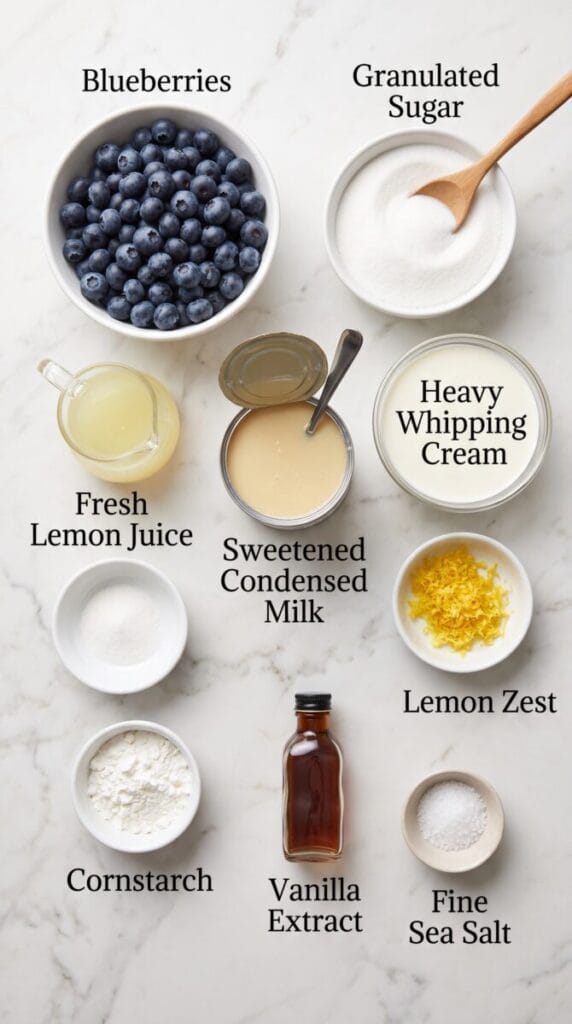
What You Need
For the blueberry swirl:
- Fresh or frozen blueberries: 1 cup (150g)
- Granulated sugar: 2 tablespoons
- Fresh lemon juice: 1 teaspoon
- Cornstarch: 1 teaspoon dissolved in 1 teaspoon cold water
For the lemon ice cream base:
- Heavy whipping cream, cold: 2 cups (480ml)
- Sweetened condensed milk: 1 can (14 oz / 397g)
- Fresh lemon juice: 3 tablespoons (about 1.5 lemons)
- Lemon zest: 2 teaspoons (about 2 lemons)
- Pure vanilla extract: 1 teaspoon
- Fine sea salt: a small pinch
How to Make It
Making the blueberry swirl (make this first so it has time to cool):
- Combine the blueberries, sugar, and lemon juice in a small saucepan over medium heat and cook, stirring occasionally, for 5 to 7 minutes until the blueberries break down and release their juice and the mixture thickens slightly.
- Stir in the cornstarch slurry and cook for another 60 seconds, stirring constantly, until the compote thickens noticeably and coats the back of a spoon.
- Remove from heat and let cool completely to room temperature — warm compote stirred into cold whipped cream will deflate it immediately. Speed the cooling by spreading it on a small plate and refrigerating for 15 minutes if needed.
Making the ice cream base:
- Whip the cold heavy cream in a large bowl with a hand mixer or stand mixer on medium-high speed until stiff peaks form — the cream should hold its shape firmly when the beater is lifted, about 3 to 4 minutes. Do not overwhip to the point of graininess.
- Whisk the sweetened condensed milk, lemon juice, lemon zest, vanilla extract, and salt together in a separate bowl until combined — the mixture will thicken slightly from the lemon juice reacting with the condensed milk proteins, which is correct.
- Pour the condensed milk mixture over the whipped cream and fold gently with a large spatula using wide, sweeping motions from the bottom of the bowl upward — fold until just combined with no streaks of white remaining, stopping before you deflate the cream.
Assembling the swirl and freezing:
- Pour half of the ice cream base into a 9×5 inch loaf pan or a similarly sized freezer-safe container.
- Drop spoonfuls of half the blueberry compote over the surface and use a skewer or butter knife to drag through it in long, sweeping strokes — the goal is visible purple-blue ribbons through the cream, not a fully mixed pale purple base.
- Pour the remaining ice cream base over the swirled layer.
- Drop the remaining compote over the surface and swirl again, this time making the swirls more visible since this top layer will be what people see when they scoop.
- Press a piece of plastic wrap directly against the surface of the ice cream — this direct contact prevents ice crystals from forming on the top surface during freezing.
- Freeze for a minimum of 6 hours. Overnight gives a firmer, more traditional scoop; 6 hours gives something closer to a soft-serve gelato texture.
- Let the ice cream sit at room temperature for 5 to 7 minutes before scooping — no-churn ice cream is typically firmer straight from the freezer than churned ice cream and needs a brief rest to scoop cleanly.
If you love the lemon-blueberry combination across different dessert formats, our Lemon and Blueberry Keto Cheesecake Fluff uses the same pairing in a no-bake, low-carb mousse format — a great lighter companion to serve alongside a scoop of this ice cream at a summer dessert table where different dietary preferences are represented.
What Makes the Texture Creamy Rather Than Icy
The sweetened condensed milk is doing most of the textural work in a no-churn ice cream — its extremely high sugar content (roughly 40 to 45 percent sugar by weight) depresses the freezing point of the mixture and prevents large ice crystals from forming. Large ice crystals are what make homemade ice cream feel gritty and icy rather than smooth; the condensed milk’s sugar interrupts their formation at the molecular level, which is why no-churn ice cream made with condensed milk has a dramatically different texture from one made with regular sugar, even at the same total sweetness level.
Cold heavy cream and cold equipment are essential for getting the whipped cream to stiff peaks efficiently — fat globules in cream whip into a stable foam only when cold. Cream at room temperature produces soft, unstable peaks that collapse almost immediately when folded into the condensed milk mixture, resulting in a flat, dense ice cream rather than a light, airy one. Chill the bowl and beaters in the freezer for 10 minutes before whipping if your kitchen is warm. According to King Arthur Baking, cold cream whips in roughly half the time of room-temperature cream and produces significantly more stable peaks that hold their structure through the folding process without deflating — the single most impactful prep step for any whipped cream-based dessert.
The cornstarch in the blueberry compote is not optional — without it, the compote remains too liquid and disperses evenly through the ice cream base rather than staying as distinct ribbons. The thickened compote holds its shape when swirled, creating visible streaks of blueberry colour that look as beautiful in a scoop as they do in the loaf pan.
What to Serve Alongside and How to Plate It
A scoop of this ice cream served alongside a slice of our Healthy Blueberry Yogurt Cake creates a genuinely composed dessert plate from two recipes that share the same core flavour — the warm spice and tender crumb of the blueberry cake against the cold, citrus-sharp cream of the ice cream is a combination that works far better than either dessert alone.
For a no-bake summer dessert table where nothing came from the oven, pair this with our Red White and Blue Cheesecake Salad — the creamy, berry-studded cheesecake salad and the scoopable ice cream together cover every texture category a summer dessert table needs without requiring a single minute of oven time.
Variations That Work With the Same Base
Replace the blueberry compote with a raspberry coulis — simmer 1 cup of raspberries with 2 tablespoons of sugar and strain out the seeds — for a version with a more intensely tart, pink-red swirl that is particularly vivid against the pale lemon base.
Swap the lemon entirely for lime juice and zest for a lime-blueberry ice cream with a slightly more tropical, aromatic quality — lime and blueberry is a less expected combination but genuinely excellent, particularly when served with fresh mango on the side.
Stir in 1/2 cup of crushed graham crackers or crumbled shortbread with the final fold for a textured version with a built-in cookie crunch — the cookies soften slightly during freezing into something between a crunchy element and a soft pocket of sweet dough, similar to cookies and cream ice cream in principle.
Use the same no-churn base with any seasonal fruit compote to create different flavours through the summer — strawberry in June, peach in August, blackberry in September. The technique is identical, the fruit is the only variable. For another seasonal fruit dessert that uses the same no-equipment, fridge-or-freezer approach, our 3-Ingredient Creamsicle Popsicles give you a hand-held frozen format from the same summer pantry without any extra shopping.
Nutritional Information
| Nutrient | Amount Per Serving (based on 8 servings, about 1/2 cup) |
|---|---|
| Calories | 310 kcal |
| Protein | 4 g |
| Carbohydrates | 34 g |
| Fats | 18 g |
These values are estimates based on the full recipe divided by 8 half-cup servings. No-churn ice cream is calorie-dense due to the sweetened condensed milk and heavy cream — the trade-off is genuine creaminess with no equipment. Smaller scoops of a genuinely rich ice cream are often more satisfying than larger scoops of a thinner version.

Storing and Keeping It at Its Best
Press plastic wrap directly against the surface of the ice cream before replacing the lid or covering — this direct-contact barrier prevents ice crystals from forming on the top layer and keeps the surface texture smooth and scoopable for the full storage period. Stored properly, this ice cream keeps in the freezer for up to 6 weeks without significant texture degradation.
If the ice cream becomes very hard after extended freezing, remove it from the freezer and let it stand at room temperature for 8 to 10 minutes rather than the usual 5 — no-churn ice cream tends to freeze harder than machine-churned over time and needs a slightly longer rest to come to ideal scooping temperature.
Avoid repeatedly returning a partially eaten container to the freezer and thawing it again — each freeze-thaw cycle increases the size of the ice crystals slightly, gradually making the texture grainier over time. Scoop what you need, return the container to the freezer immediately with the plastic wrap pressed back against the surface, and it will hold its texture well for the full six weeks.
Mistakes That Make It Icy Instead of Creamy
Adding warm blueberry compote to the whipped cream mixture deflates the cream immediately from the heat — the compote must be completely cool, not just warm to the touch, before it goes anywhere near the whipped cream. Room temperature or cold is the target.
Under-whipping the cream to soft rather than stiff peaks produces a base that collapses into the condensed milk rather than maintaining its aerated structure — the stiff peaks that hold their shape firmly when the beater is lifted are the air structure that creates the creamy texture in the finished ice cream. Soft peaks equal flat, dense ice cream.
Skipping the plastic wrap directly on the surface causes ice crystals to form on the top layer as the ice cream freezes — the air gap between the ice cream surface and any lid or loose covering creates the exact temperature and humidity conditions that produce those coarse crystals. Direct contact is the fix, every time.
Lemon Blueberry
Ice Cream
Creamy, bright, and incredibly simple. A rich lemon ice cream base made with whipped cream and condensed milk, layered with a beautiful, jammy homemade blueberry swirl.
Ingredients
Instructions
Add the blueberries, granulated sugar, and lemon juice to a small saucepan over medium heat. Cook for 5–7 minutes, stirring occasionally, until the berries break down and release their juices.
Mix the cornstarch with 1 teaspoon of cold water to make a slurry. Stir it into the blueberry mixture and cook for another 60 seconds, stirring constantly, until the compote thickens and coats the back of a spoon.
Remove the compote from the heat and let it cool completely to room temperature. For faster cooling, spread it onto a plate and refrigerate for 15 minutes.
In a large bowl, whip the cold heavy cream with a hand mixer or stand mixer on medium-high speed for 3–4 minutes until stiff peaks form. Do not overwhip.
In a separate bowl, whisk together the sweetened condensed milk, fresh lemon juice, lemon zest, vanilla extract, and salt until smooth and combined.
Pour the condensed milk mixture over the whipped cream. Gently fold with a spatula using wide, sweeping motions until fully combined. Be careful not to deflate the whipped cream.
Pour half of the lemon ice cream mixture into a 9×5-inch loaf pan or freezer-safe container.
Drop spoonfuls of half the cooled blueberry compote over the ice cream. Use a skewer or butter knife to gently swirl the blueberry mixture through, creating visible ribbons.
Pour the remaining ice cream mixture into the pan. Add the remaining blueberry compote on top and gently swirl again.
Press a piece of plastic wrap directly against the surface of the ice cream to help prevent ice crystals from forming.
Freeze for at least 6 hours for a soft gelato-like texture, or freeze overnight for firmer scoops.
Let the ice cream sit at room temperature for 5–7 minutes before scooping and serving.
Kitchen Notes
Make absolutely sure the blueberry compote is completely cool before adding it to the ice cream base, otherwise it will melt the whipped cream.
Use very cold heavy cream for the most stable stiff peaks. If your kitchen is hot, chill the mixing bowl and beaters in the freezer for 10 minutes first.
Watch the heavy cream closely. If you overwhip it, it will become grainy, separate, and be very difficult to fold into the condensed milk.
Pressing plastic wrap directly against the surface of the ice cream before freezing seals out the air, minimizing ice crystal formation.
Store in a tightly covered freezer-safe container for up to 6 weeks for the best quality and texture.
If the ice cream becomes very firm after extended freezing, let it sit at room temperature for 8–10 minutes before scooping.
Avoid repeatedly thawing and refreezing, as repeated freeze-thaw cycles create larger ice crystals and make the texture grainy.