
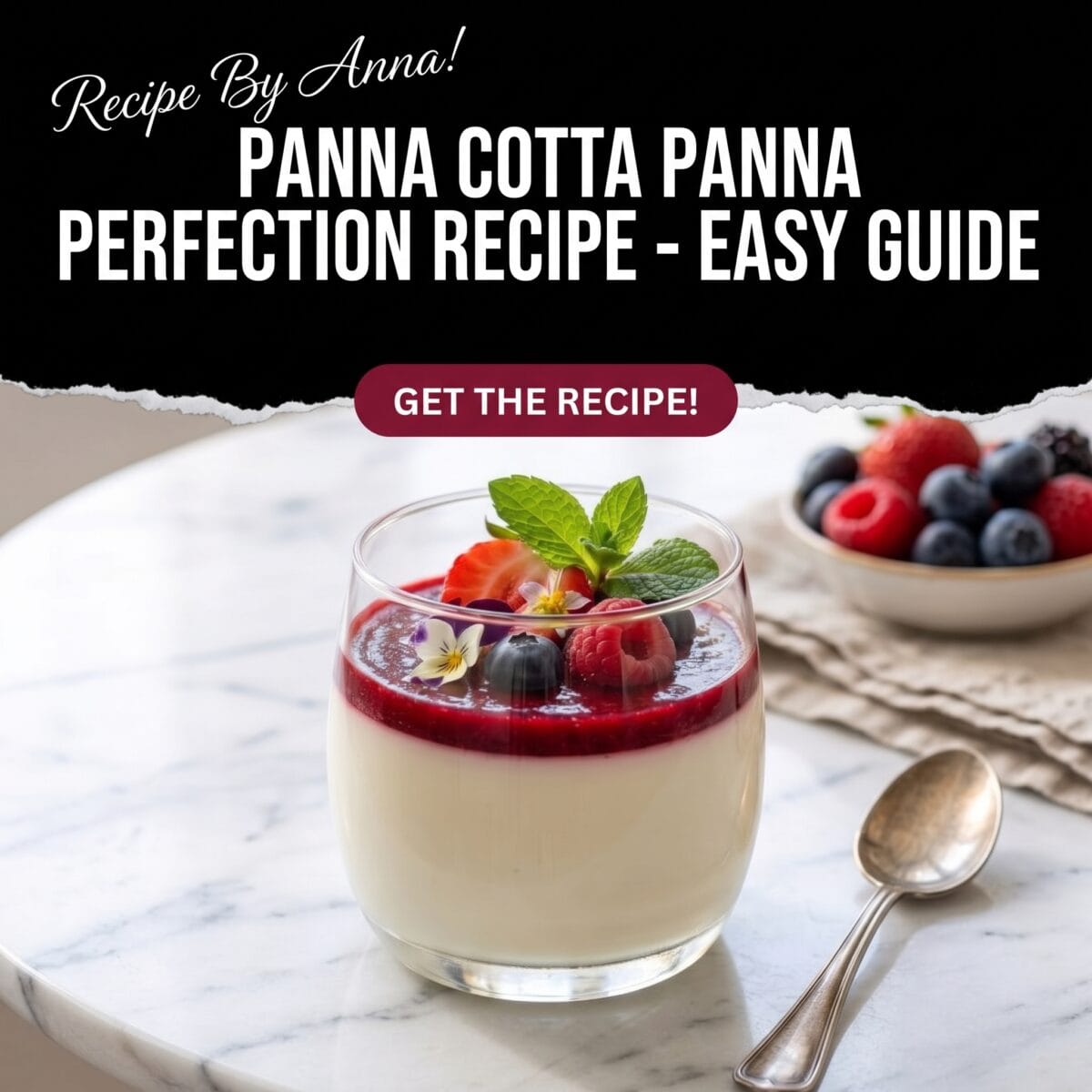
Panna Cotta — Perfect Panna Cotta Every Time
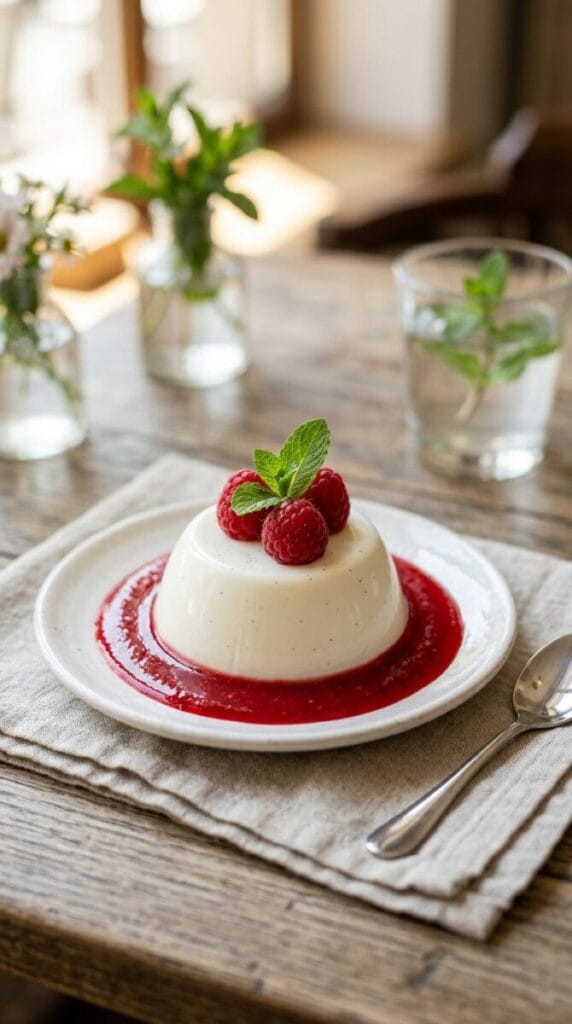
This Panna Cotta recipe is the Italian dessert that looks like it came from a Michelin-starred kitchen and takes fifteen minutes to make — a barely-set, silky, quivering column of sweetened cream flavoured with vanilla that unmolds onto a plate with a satisfying wobble and sits there looking genuinely beautiful until the first spoon breaks through.
Panna cotta (literally “cooked cream” in Italian) is one of those recipes where the technique is almost entirely about ratios rather than skill — the amount of gelatin relative to the cream is what determines whether you have a dessert that holds its shape on a plate with that characteristic gentle tremor or one that is either rubbery and stiff or too soft to unmold. Get the ratio right and the rest follows almost automatically.
This recipe produces a panna cotta that sits at the ideal point on the set spectrum — just firm enough to unmold cleanly and hold a round shape on the plate, but soft enough that the first spoon goes through without resistance and the texture inside is genuinely silky rather than gelatinous. It is the result of testing multiple gelatin ratios across multiple batches until the wobble was exactly right.
Why Panna Cotta Is the Best Dinner Party Dessert You Can Make
It is made entirely the day before, requires no baking, needs no special equipment beyond a saucepan and some ramekins or glasses, and takes the total attention of one person for about fifteen minutes — which means the person making the dinner can have the dessert done and refrigerating while the main course is still in the planning stage.
It also scales flawlessly — doubling or tripling the recipe requires exactly the same effort as a single batch, and the individual portion format means no slicing, no serving anxiety, and no dessert that loses presentation quality between the kitchen and the table.
- Prep Time: 15 minutes
- Chill Time: 4 hours minimum, overnight preferred
- Total Time: 15 minutes active, 4 to 12 hours total
- Yield: 6 individual panna cottas
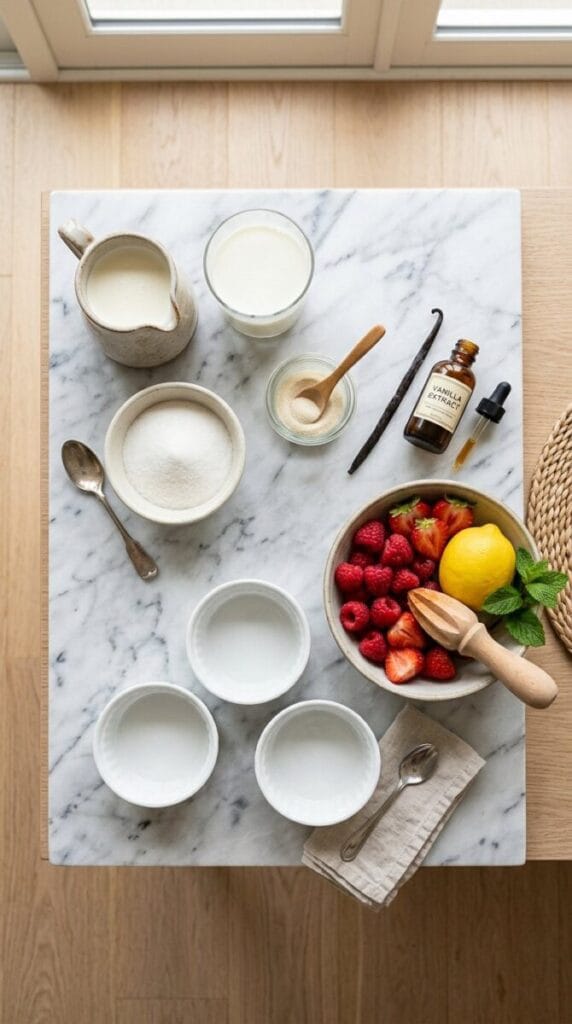
What You Need
For the panna cotta:
- Heavy whipping cream: 2 cups (480ml)
- Whole milk: 1 cup (240ml) — the milk lightens the texture compared to all-cream, producing a more delicate result
- Granulated sugar: 1/3 cup (65g)
- Unflavoured powdered gelatin: 2 1/4 teaspoons (1 standard packet / 7g) — this is the precise amount for a perfectly set, trembling panna cotta in a ratio of 3 cups liquid to 2 1/4 teaspoons gelatin
- Cold water: 3 tablespoons, for blooming the gelatin
- Pure vanilla extract: 2 teaspoons, or 1 vanilla bean, split and scraped
- Fine sea salt: a tiny pinch
For a classic berry coulis:
- Fresh or frozen mixed berries (raspberries, strawberries, or a mix): 1 1/2 cups (225g)
- Granulated sugar: 3 tablespoons
- Fresh lemon juice: 1 tablespoon
How to Make It
Making the panna cotta:
- Lightly grease 6 small ramekins (4 oz / 120ml each) with a neutral oil using a pastry brush or a piece of paper towel — just a thin film of oil on the sides and base is enough to release the panna cotta cleanly when unmolded. For serving in glasses rather than unmolding, skip the greasing entirely.
- Sprinkle the gelatin powder evenly over the cold water in a small bowl and let it sit undisturbed for 5 minutes — this blooming step is essential. Gelatin added directly to warm liquid without blooming first forms lumps that don’t fully dissolve and produce a panna cotta with uneven texture and visible gelatin bits.
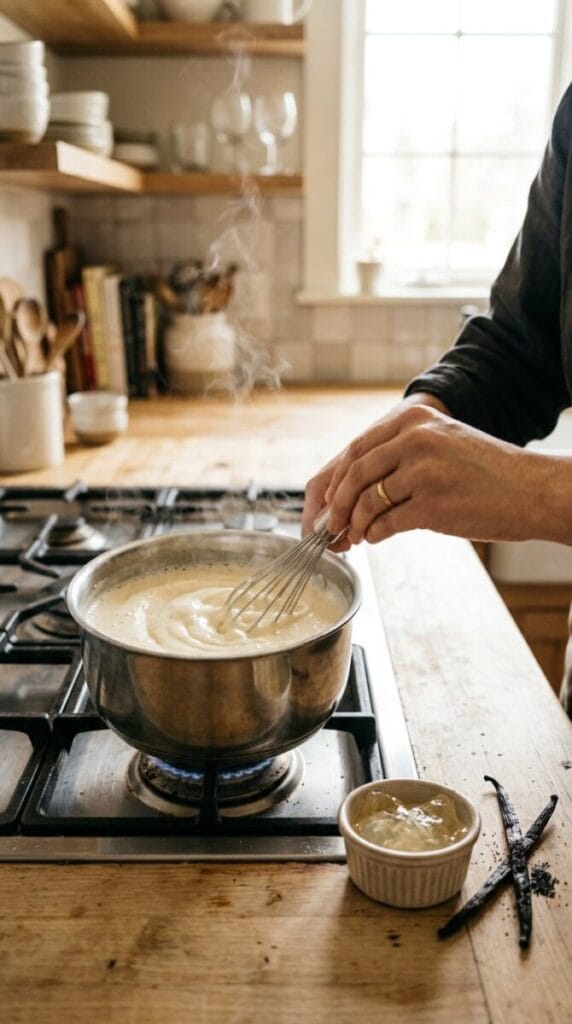
- Combine the heavy cream, whole milk, and sugar in a medium saucepan over medium heat and stir until the sugar dissolves. Heat until steaming and small bubbles form at the edges — do not boil. Boiling cream can cause the milk solids to scorch at the bottom and gives the panna cotta a slightly cooked flavour.
- Remove the pan from the heat and add the bloomed gelatin, stirring gently but thoroughly for 1 to 2 minutes until the gelatin is completely dissolved — hold the bowl up to the light and look for undissolved granules. Even one or two undissolved granules will create small, rubbery specks in the finished dessert.
- Stir in the vanilla extract or scraped vanilla bean seeds, and the pinch of salt.
- Let the mixture cool for 10 minutes, stirring occasionally — pouring very hot cream into cold ramekins can crack glass ramekins and also causes the mixture to set unevenly at the edges before it has finished pouring.
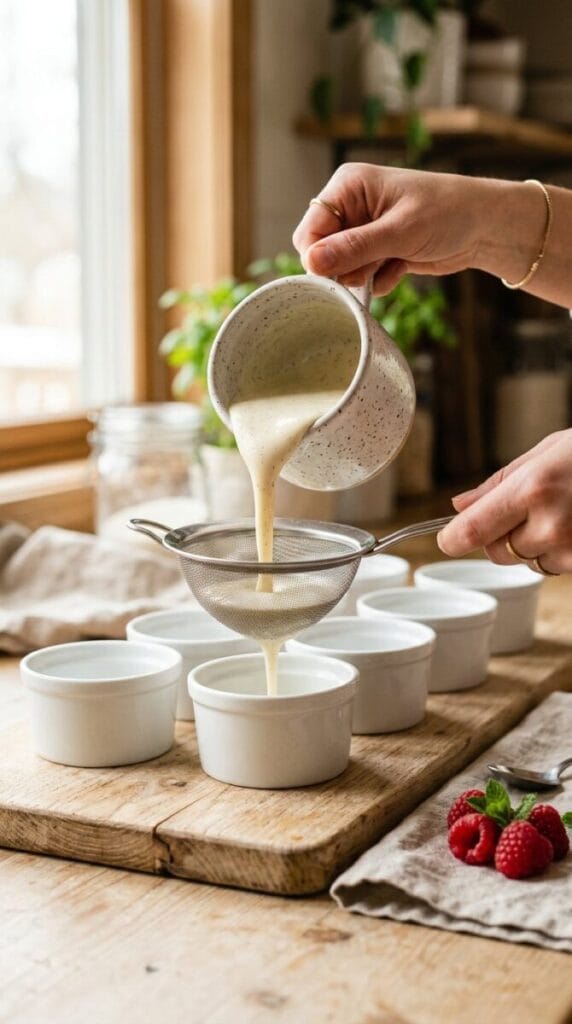
- Pour the mixture through a fine mesh strainer into a jug or measuring cup with a pour spout — the strainer catches any undissolved gelatin particles, vanilla bean pod pieces, or any other undissolved material, and the pour spout makes filling the ramekins cleanly much easier.
- Pour the mixture into the prepared ramekins, dividing it evenly — each ramekin should be filled to about 1/2 inch from the top to allow room for the coulis at serving.
- Let the ramekins cool to room temperature, then cover each with plastic wrap and refrigerate for at least 4 hours — overnight produces the cleanest unmold and the best-set texture.
Making the berry coulis:
- Combine the berries, sugar, and lemon juice in a small saucepan over medium heat and cook for 5 to 7 minutes, stirring occasionally, until the berries have broken down completely and the mixture has thickened slightly.
- Strain through a fine mesh sieve, pressing on the solids with the back of a spoon to extract all the juice. Discard the seeds and skins.
- Taste and adjust — more lemon if it needs brightness, more sugar if it tastes too sharp. Cool completely and refrigerate until ready to use. The coulis keeps for up to 5 days in the fridge.
Unmolding and serving:
- To unmold, run a thin knife or offset spatula gently around the edge of each ramekin to break the seal between the panna cotta and the ramekin wall.
- Place a plate face-down on top of the ramekin, then flip both together in one quick, confident motion — hesitation at this stage causes the panna cotta to partially release and tear.
- If it does not release immediately, dip the bottom of the ramekin in very warm water for 10 seconds, then try again.
- Spoon the cold berry coulis around and over the unmolded panna cotta and serve immediately.
Panna cotta is the Italian make-ahead dessert that anchors any elegant dinner party spread. For a full dinner that ends with this dessert, our Chicken Pad Thai is the crowd-pleasing main course that serves the same number of people from the same 30-minute cook window — a practical pairing of a quick main and a make-ahead dessert that makes hosting significantly more manageable.
The Gelatin Ratio — Why It Is the Only Number That Truly Matters
Every panna cotta problem — too rubbery, too soft, won’t unmold, collapses when unmolded — comes back to the gelatin-to-liquid ratio. Too much gelatin and the result is stiff, chewy, and bounces on the plate rather than trembling. Too little and it won’t hold its shape out of the ramekin, pooling into a puddle when unmolded.
The ratio in this recipe — 2 1/4 teaspoons (one standard packet) of gelatin for every 3 cups of liquid — is the classic Italian panna cotta ratio that produces the characteristic gentle wobble. If you want to serve in glasses rather than unmold onto plates, reduce the gelatin to 1 1/2 teaspoons for the same volume of liquid — in a glass, the panna cotta doesn’t need to hold a freestanding shape, and the slightly softer set produces a more delicate, spoonable texture.
Blooming the gelatin in cold water before heating is the technique step that produces smooth, even setting throughout — unbloomed gelatin added directly to warm liquid forms clumps where the exterior hydrates faster than the interior, producing small, dense gelatin lumps suspended in an under-set cream rather than an evenly gelled mixture. According to Serious Eats, gelatin granules absorb cold water slowly and evenly, allowing full hydration before the heat melts them into solution — adding them directly to hot liquid causes the outer surface to melt and form a protective skin around the still-dry interior, preventing complete dissolving regardless of how long the mixture is stirred.
Flavour Variations on the Same Base Recipe
The vanilla base recipe is the foundation that takes any flavour direction easily — replace the vanilla extract with any of the following without changing any other part of the recipe.
Coffee panna cotta: Dissolve 2 teaspoons of instant espresso powder in the warm cream before adding the gelatin. Serve with a dark chocolate drizzle or a spoonful of whipped cream and a dusting of cocoa powder. This is the variation most likely to impress people who consider themselves too sophisticated for vanilla desserts.
Coconut panna cotta: Replace 1 cup of the heavy cream with 1 cup of full-fat canned coconut milk for a tropical direction that pairs with mango coulis or toasted coconut flakes. The coconut milk slightly lightens the texture while adding a distinct, clean coconut flavour.
Lemon panna cotta: Add 2 teaspoons of lemon zest and 1 tablespoon of fresh lemon juice to the cream before heating. Strain out the zest before pouring. Serve with the blueberry coulis from our Lemon Blueberry No-Churn Ice Cream — the same lemon-blueberry pairing works in a panna cotta format as naturally as it does in the ice cream.
Matcha panna cotta: Whisk 1 tablespoon of ceremonial-grade matcha powder with 2 tablespoons of the warm milk until completely smooth before adding to the rest of the cream mixture — adding the matcha directly without pre-mixing produces clumps that don’t fully dissolve.
Recommended Kitchen Tools for the Best Panna Cotta
6 essential tools for silky texture, smooth mixing, and a perfectly set finish.Panna cotta is simple to make, but temperature control and smooth mixing are key to getting that silky, creamy texture and perfectly set finish. These 6 essential tools make the process easier and more reliable.

Small Saucepan
A quality saucepan gently heats the cream, sugar, and other ingredients without scorching. Even heating is important for smooth panna cotta.
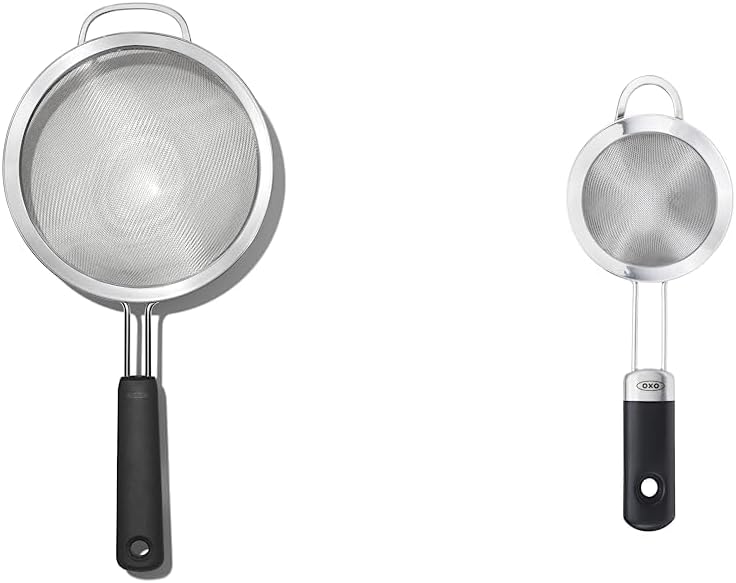
Fine-Mesh Strainer
Straining the mixture removes undissolved gelatin or tiny lumps for a perfectly smooth, restaurant-quality texture.

Small Whisk
A whisk dissolves the gelatin and sugar evenly into warm cream while helping prevent lumps from forming.

Measuring Cups
Accurate liquid measurements help balance the cream, milk, and gelatin so the panna cotta sets properly without becoming too firm.

Ramekins
Individual ramekins are perfect for portioning panna cotta and make chilling and serving simple with a clean, elegant shape.

Silicone Spatula
A flexible spatula scrapes the saucepan and bowl clean while gently stirring the cream mixture without introducing too much air.
As an Amazon Associate we earn from qualifying purchases.
Nutritional Information
| Nutrient | Amount Per Serving (panna cotta with berry coulis) |
|---|---|
| Calories | 320 kcal |
| Protein | 4 g |
| Carbohydrates | 22 g |
| Fats | 24 g |
These values are estimates based on the full recipe including the berry coulis, divided by 6 servings. The fat comes primarily from the heavy cream — panna cotta is a genuinely rich dessert, and these values reflect a full individual portion honestly rather than an optimistic half-portion.
Storage and How Long Panna Cotta Keeps
Covered in their ramekins, unmolded panna cottas keep in the fridge for up to 3 days — the gelatin structure remains stable and the flavour actually improves between day one and day two as the vanilla infuses more fully into the cream. Keep them covered with plastic wrap pressed against the surface to prevent a skin from forming.
Once unmolded, serve within 2 hours — an unmolded panna cotta sitting at room temperature will begin to soften at the base where it contacts the warm plate surface. Plate them just before service rather than hours ahead if presentation matters.
Panna cotta does not freeze — the gelatin structure collapses on thawing and the cream separates, producing a liquid mess rather than anything resembling the original dessert.
Why the Panna Cotta Won’t Unmold and How to Fix It
If the panna cotta sticks to the ramekin despite the thin oil coating, the most reliable fix is the warm water bath — dip the bottom and sides of the ramekin in a bowl of very warm (not boiling) water for 10 to 15 seconds, dry the outside, then re-run the knife around the edge and try the flip again. The warmth contracts the ramekin slightly and breaks the suction seal that is holding the panna cotta against the walls.
If the panna cotta collapses into a soft pool when unmolded, the gelatin quantity was insufficient or the set time was too short — a panna cotta that didn’t set properly cannot be rescued after the fact. The only solution is to remelt it in a saucepan, add a little extra bloomed gelatin (1/2 teaspoon bloomed in 1 tablespoon of cold water), and return to the fridge for the full 4-hour setting period.
If the panna cotta is rubbery and bouncy rather than silky and trembling, the gelatin quantity was too high — a rubbery result can be served in the glass rather than unmolded, where the texture is somewhat less noticeable and the visual presentation doesn’t rely on the freestanding shape. Make a note to reduce the gelatin by 1/4 teaspoon next time.
Perfect Silky
Panna Cotta
The classic Italian “cooked cream” dessert. Silky, quivering, and beautifully vanilla-scented. It’s the ultimate make-ahead dinner party dessert that looks and tastes like a Michelin-starred creation.
Ingredients
Instructions
Lightly grease 6 ramekins with a neutral oil using a paper towel. (Or skip this if serving in glass cups).
Sprinkle gelatin over 3 tbsp cold water in a bowl. Let sit for 5 minutes. This is the most critical step to avoid lumps!
Combine cream, milk, and sugar in a saucepan. Heat until steaming and small bubbles form at the edges. Do not boil!
Remove from heat. Add bloomed gelatin and stir for 1–2 minutes until completely dissolved. Hold it to the light to ensure no granules remain.
Simmer berries, sugar, and lemon juice in a saucepan for 5–7 minutes until broken down.
Kitchen Notes
Always sprinkle gelatin over cold water and let it sit for 5 minutes. If added directly to warm liquid, it will clump into rubbery bits.
Keep the cream mixture at a gentle steam. If the cream boils, the milk solids will scorch and ruin the delicate flavor.
This recipe uses a 3 cups liquid to 2¼ tsp gelatin ratio. If you want a softer set (for glasses), reduce the gelatin to 1½ tsp.
If the panna cotta won’t release, dip the bottom of the ramekin in warm water for 10 seconds. The slight heat releases the suction.
Keep in ramekins covered with plastic wrap for up to 3 days.
Once unmolded, serve within 2 hours as they will begin to soften at room temperature.
Freezing destroys the gelatin structure and causes the cream to separate.